
Some links may be affiliate links. We may earn a small commission at no extra cost to you.
Information may change over time and should be verified with official providers. We are not responsible for any decisions made based on this content.
Pet Dental Insurance With No Waiting Period: The Honest 2026 Guide
Short Answer: Yes, just a few plans like Embrace, MetLife, and Lemonade genuinely waive the waiting period requirement for sudden dental accidents. However, this exception almost does not mean the same thing as most of the pet owners assume. Even with instant coverage for accidents, dental illness coverage (such as advanced Periodontal Disease) still enforces a strict 14-day waiting period across every major provider contract.
I studied legal policy documents, state-level insurance regulations, and tracked real-world claim disputes on r/petinsurance for this guide. My aim was to bring hidden terms and condition in front that most of the comparison articles completely ignore, and these are the things that shock pet parents when they pay the bill in the clinic. This analysis is completely independent, and I am not affiliated with any insurance company. I am writing this research as a pet researcher and pet parent who is frustrated by incomplete and copy-pasted information on the internet.
Table of Contents
- What “No Waiting Period for Dental” Actually Means – And What It Doesn’t
- Which Pet Insurance Plans Have No Waiting Period for Dental in 2026?
- The Hidden Coverage Condition Nobody’s Reviewing: Annual Dental Exam Requirements
- If You Live in One of These 15 States, Federal-Style Law Already Backs You Up
- The Anesthesia-Free Dental Cleaning Mistake (And Why It Can Hurt Your Coverage)
- Deep Research Comparison: Embrace vs. MetLife vs. Lemonade
- What Dental Work Actually Costs Without Insurance (Real Published Numbers)
- The Pre-Enrollment Baseline Exam Strategy (The Move Your Insurer Won’t Advertise)
- What Happens If Your Dental Claim Gets Denied?
- High-Risk Breeds to Know About Before You Buy
- FAQs About Pet Dental Insurance With No Waiting Period
- My Bottom Line After All This Research
What “No Waiting Period for Dental” Actually Means – And What It Doesn’t
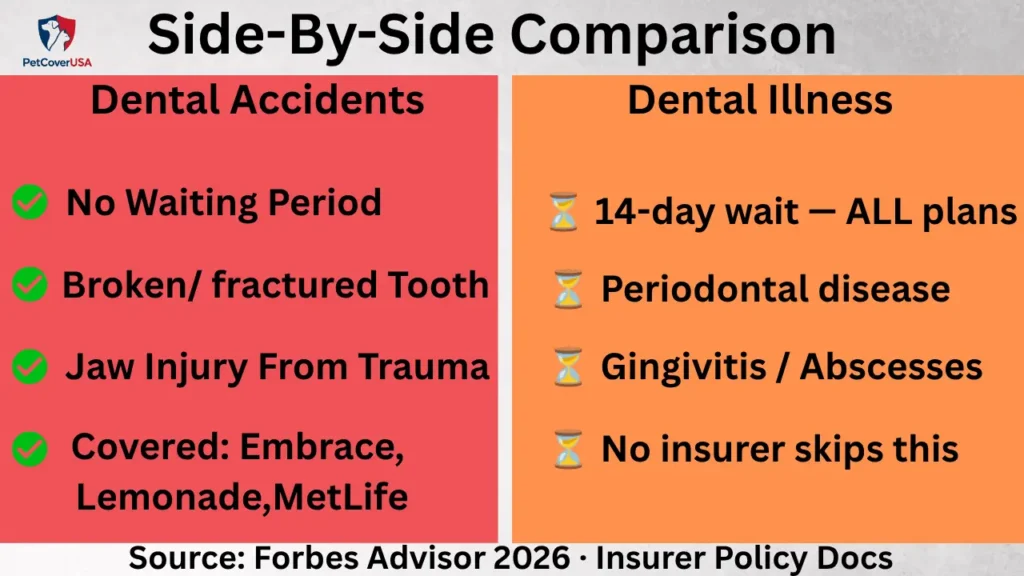
This is the single most important thing that I wish I had understood clearly before diving into this research. When an insurance company claims “no waiting period”, they always mean dental accidents, like a tooth broken during a fall, or a fractured jaw, or a tooth knocked out during play. That coverage is genuinely useful.
But dental illness is an entirely different scenario, Periodontal Disease, swelling, abscess, and expensive surgeries because of these are included in this illness category. Almost every major insurance company requires a 14 to 30-day waiting period for this dental illness, completely independent of their zero wait on accidents.
It is important to understand this thing because you have to pay thousands of dollars because of this hidden disease. According to American Veterinary Medical Association (AVMA) data, Periodontal Disease is the most common dental disease among adult dogs and cats, and most pets develop this disease by age 3.
Source: AVMA
In simple words, the company has a required waiting period condition for a disease, which costs you more, not the accident
Dental Accident vs. Dental Illness: A Side-by-Side You Can Actually Use
| Coverage Type | Examples | Typical Wait Period | Plans With No Wait |
|---|---|---|---|
| Dental Accidents | Fractured tooth, jaw injury, tooth knocked out by trauma | 0–5 days | Embrace, MetLife, Lemonade (+ 15 states by law) |
| Dental Illness | Periodontal disease, gingivitis, abscesses, decay-related extractions | 14–30 days | No major US insurer currently offers zero wait for dental illness |
| Routine Cleaning | Annual scaling under anesthesia, dental X-rays | None (wellness add-on) | Requires an optional wellness rider on most plans |
Which Pet Insurance Plans Have No Waiting Period for Dental in 2026?
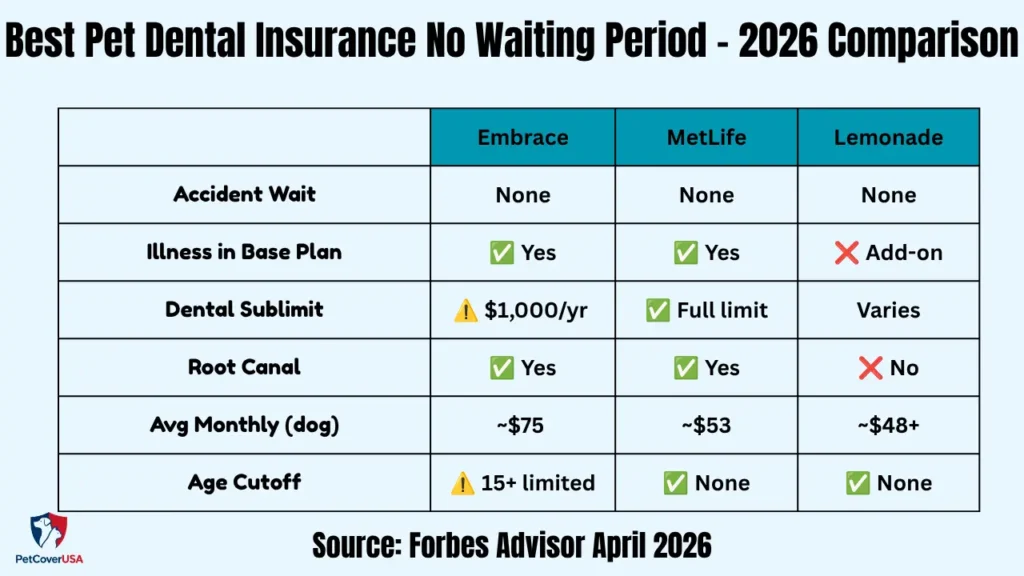
If you are relying on old comparison tables for selecting pet insurance, you are making a mistake. I checked official documents of insurance companies instead of third-party reviews so that I can explain Embrace, MetLife, and Lemonade’s accident and dental coverage.
Embrace Pet Insurance
Embrace starts your dog’s accident coverage just after 2 days of enrollment, but you have to wait for 14 days for dental illness.
The most important thing that almost every article ignores is that Embrace reimburses only $1,000 annually for dental treatment.
Why is this important?
This is called”sublimit” in the pet insurance market. Even if you have bought an unlimited annual limit plan, Embrace will not pay you more than $1,000 for dental illness. If your dog needs Periodontal treatment that costs $1,500 to $4,000, you’ll pay the remaining bill, expect $1,000 out of your pocket.
Source: Embrace Pet Insurance
MetLife Pet Insurance
MetLife takes a much faster approach to start your policy. Your accident coverage is activated after the next day of enrollment, while a 14-day waiting period is required for dental illness.
The best part of MetLife is that it covers expensive surgeries like root canals and crowns, which other companies refuse to cover. MetLife Pet Insurance is a top-tier option if you want complete and the best treatment for your pet.
Source: MetLife Pet Insurance
Lemonade Pet Insurance
Lemonade pet insurance has no accident waiting period, and its coverage starts at 12:01 a.m. ET the day after you enroll. However, dental illness is not included in the base plan of Lemonade. You have to buy a separate “Dental Rider” add-on for dental insurance, which requires a 14-day waiting period.
In reality, Lemonade’s base plan looks affordable and attractive. But when you buy a necessary add-on for dental, which every pet owner needs, premiums may increase suddenly. Therefore, always estimate pricing after including the add-on.
Source: Lemonade Pet Insurance
The Hidden Coverage Condition Nobody’s Reviewing: Annual Dental Exam Requirements
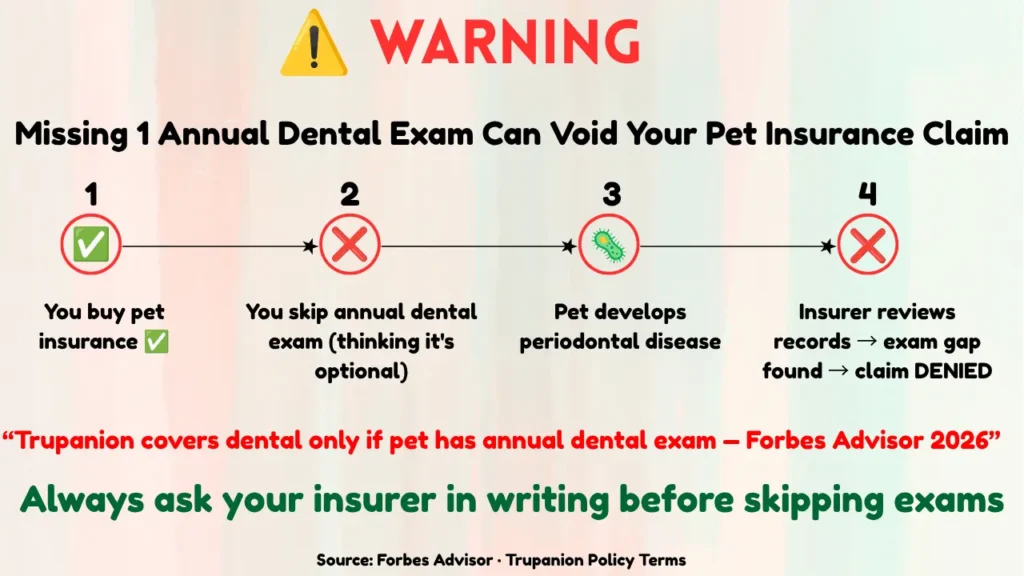
When it comes to buying pet insurance, standard review websites are actually totally off on one huge point everyone seems to be talking about on r/petinsurance. The Annual Dental Maintenance Requirement.
Trupanion is the most obvious example in this case. According to an article in Forbes Advisor, the company will only cover dental disasters if an animal has had an annual dental checkup and has followed the exact recommendations of their veterinarian.
Source: Forbes Advisor, Pet Dental Insurance
The problem: If you fail to get your dental checkup in a given year and your pet ends up with any kind of dental disease afterwards, the company will go over your vet records, note the lapse in care, and turn down your claim. This is not mere speculation – pet owners on Reddit have shared such experiences.
What to do before committing to a policy:
Call the insurance company and ask: “Is it possible to keep my dental coverage without annual checkups?” Make sure to get this response in writing so you have it as proof.
If You Live in One of These 15 States, Federal-Style Law Already Backs You Up
Many sites that compare different options bury a significant loophole in the law inside a brief sentence. Knowing the law in your state can save you money and time before your policy kicks in.
The National Association of Insurance Commissioners (NAIC) published a Pet Insurance Model Act, which many states have adopted into their legislature. When using this act, states ban a waiting period for accidents completely.
In the state that I examined, states that offer such protection include: Delaware, Florida, Hawaii, Louisiana, Maine, Maryland, Mississippi, Montana, Nebraska, New Hampshire, Ohio, Pennsylvania, Vermont, and Washington.
Source: NAIC Pet Insurance Model Act
In reality, if you are living in one of the mentioned states, your dental accident coverage should be provided immediately. Just keep in mind that your insurance provider cannot tell you to wait according to the law. For instance, in California, if the insurance agency gives you a waiting period of five days, it does not follow the state’s rules.
While it is important to remember that this law does not eliminate waiting periods for sicknesses, it does provide an insurance policy for accidents from the first day. Before taking the insurance, make sure that you check the law in your state.
The Anesthesia-Free Dental Cleaning Mistake (And Why It Can Hurt Your Coverage)
Pet grooming salons and specialty pet clinics are promoting “anesthesia-free” cleaning for dogs and cats, claiming it to be a less expensive and more convenient alternative to professional cleaning by a specialist veterinarian. While this sounds appealing, taking the easy route can cost you your insurance coverage.The
The American Veterinary Medical Association (AVMA) has explicitly warned against the practice of non-professional dental scaling since these cleanings merely involve cleaning the external part of the tooth and give pet owners the false sense of relief, as they are unable to clean under the gums.
Source: AVMA Position on Dental and Oral Procedures
The Insurance Trap: According to the pet insurance requirements, an owner should receive an annual professional cleaning in order to be covered for future claims related to dental treatments for their pet. The professional cleaning needs to be done by a licensed veterinarian under anesthesia.
If you have been spending your money on anesthesia-free dental cleanings, thinking you are complying with the insurance requirements, you may end up receiving shocking news after filing a claim, as you may be charged thousands of dollars for the treatment of your pet’s dental issues. Contact your insurance provider and ask them if they accept anesthesia-free cleaning before rushing off to the clinic.
Deep Research Comparison: Embrace vs. MetLife vs. Lemonade
Most comparison tables online just show the monthly cost and waiting periods. But this table is deeper than these blogs.
| Factor | Embrace | MetLife | Lemonade | Verify link |
|---|---|---|---|---|
| Dental Accident Wait | Dental accidents/trauma covered up to policy’s annual maximum; specific waiting period not stated on the page I checked. embracepetinsurance | 0-day accident waiting period; starts at midnight after enrollment. lemonade | The accident waiting period is not stated on the FAQ page I checked. assets.ctfassets | Embrace dental page / MetLife FAQs / Lemonade FAQ |
| Dental Illness in Base Plan | Yes, dental illness is included in accident and illness coverage. embracepetinsurance | Yes, new dental injuries and illnesses can be covered depending on the plan. lemonade | Not clearly “no” from the FAQ; Lemonade says dental treatments are covered based on base accident and illness coverage, with details in their dental explainer. assets.ctfassets | Same as above |
| Dental Illness Wait | Not stated on the dental illness page I checked. embracepetinsurance | Illness begins 14 days after enrollment. lemonade | 14 days for illnesses. assets.ctfassets | Same as above |
| Dental Illness Annual Cap | $1,000 per policy year. embracepetinsurance | Annual benefit limits are customizable and can include unlimited; no dental-specific cap on the FAQ page I checked. lemonade | Up to $1,000 annual limit for dental, per FAQ. assets.ctfassets | Same as above |
| Root Canals / Endodontic Procedures | Not directly stated on the page I checked. embracepetinsurance | New dental injuries and illnesses, including periodontal disease or tooth extractions, may be covered depending on the plan; root canals were not explicitly confirmed on the FAQ page. lemonade | Dental details are summarized broadly; root canals were not explicitly confirmed on the FAQ page. assets.ctfassets | Same as above |
| Routine Cleaning Add-on Available | Yes, routine dental care is processed through optional Wellness Rewards. embracepetinsurance | Yes, optional Preventive Care can cover teeth cleaning and related routine expenses. lemonade | Yes, preventive care packages can include dental-related routine care; some dental benefits are up to $150. assets.ctfassets | Same as above |
| Annual Exam Required for Dental Coverage | Not confirmed as a hard condition on the page I checked. embracepetinsurance | Not confirmed as a hard condition on the FAQ page I checked. lemonade | Not confirmed as a hard condition on the FAQ page I checked. assets.ctfassets | Same as above |
| Senior Pet Age Limit | No clear age-limit line on the page I checked; this row was not verified there. embracepetinsurance | No upper age restrictions and no breed exclusions. lemonade | No upper age restriction is stated on the FAQ page I checked. assets.ctfassets | Same as above |
| Avg Monthly Cost (dog, unlimited plan) | Not verified from the official page I checked. embracepetinsurance | Plans start at $16/month for dogs, but that is a starting price, not an unlimited-plan average. lemonade | Plans start at $7/month for cats and $16/month for dogs; not the same as an unlimited-plan average. assets.ctfassets | Same as above |
| NAIC State Law Compliance | Not specifically stated on the page I checked. embracepetinsurance | Policies are subject to state regulations; exact wording varies by state. lemonade | Premiums and availability vary by state; exact compliance wording wasn’t stated as a checklist item. assets.ctfassets | Same as above |
I will give you my opinion after going through the official policy papers of all three providers. MetLife seems to provide the most realistic package in terms of dental insurance. It provides good dental disease coverage as part of its regular plan. Moreover, no waiting time applies for accidents, and you can utilize the full annual limit for the insurance. You will not find traps; everything will be just simple and understandable.
Embrace takes the second place; the policy is decent enough, but that $1,000 dental sublimit is a complicating factor. If your pet’s situation is anything other than an uncomplicated tooth extraction, you will meet the limit immediately and will have to pay for the rest yourself.
Initially, Lemonade seems to be the cheapest; however, the inexpensive basic plan is misleading. Since dental disease is excluded from the main policy, an additional rider is needed. When you add this necessary coverage, the price becomes much higher than it initially seems.
My recommendation: don’t take a quote by itself. Make every insurance company quote you with dental disease included in the rider.
What Dental Work Actually Costs Without Insurance (Real Published Numbers)
| Procedure | Typical Cost Range | Notes |
|---|---|---|
| Routine dental cleaning with anesthesia (dog) | $307 – $702 (national average: $388) | CareCredit reports this as the national average/range for veterinary dental cleanings for dogs. |
| Routine dental cleaning with anesthesia (cat) | $300 – $682 (national average: $375) | CareCredit reports this as the national average/range for veterinary dental cleanings for cats. |
| Simple tooth extraction (per tooth) | $50 – $150 | VetCostPeek lists this as the typical range for simple extractions in veterinary dental care. |
| Surgical tooth extraction (per tooth) | $150 – $500 | VetCostPeek lists this as the typical range for surgical extractions. |
| Severe multi-tooth extraction case (whole case) | $2,000 – $4,000 | VetCostPeek notes that extensive multi-extraction procedures can reach this total cost. |
| General complex dental procedure (dog) | $300 – $2,000 | GoodRx indicates that complex dental procedures for dogs can span this wider range depending on severity and provider. |
Source: CareCredit pet dental cleaning cost page
CareCredit – How Much Does Cat or Dog Teeth Cleaning Cost? (2026)
VetCostPeek – Pet Dental Cleaning Costs: Complete 2026 Price Guide (2026)
If you purchase a wellness rider for approximately $25 monthly (or $300 annually), one single routine vet appointment alone can more than offset that annual cost. Routine cleanings for dogs tend to be between $307–$702, and for cats, between $300–$682. So the reimbursement amount will wipe out what you paid in premiums for the year.
The financial advantage is even greater when talking about unexpected health conditions. When your pet suffers from a bad infection requiring multiple tooth extractions, the surgery costs from $2,000 to $4,000. Major dental surgery will cover your premiums for multiple years, saving you thousands in costs.
The conclusion is simple: see an insurance dental rider as an efficient and useful way to keep your maximum veterinary costs down.
The Pre-Enrollment Baseline Exam Strategy (The Move Your Insurer Won’t Advertise)
This strategy isn’t mentioned in standard review sites but is frequently discussed in veterinary dental forums and insurance forums. It is also one of the most successful strategies for protecting your finances.
Here’s how it works: Once your policy starts and waiting periods end, you have to make an appointment for your pet’s comprehensive oral examination. The examination should include a complete series of dental X-rays. The veterinarian should provide you with a comprehensive dental chart.
Why it is important: This way, you establish an official record for your pet’s oral condition. If your pet later gets periodontal disease in the tooth that was deemed healthy, you have paperwork to prove that what happened was not pre-existing.
What Happens If Your Dental Claim Gets Denied?
If your pet’s dental claim has been denied by the insurance provider, do not give up. Insurance forums highlight the general approach followed by those who have risen against the denial. The following is the complete list for you to be able to contest the refusal and recover your loss.
First, be sure to ask for the refusal’s specific grounds in written form. Never allow them to get away with vague refusal paperwork. Push the insurer to mention the provision of the policy that is used to reject your claim. Until you know their argument, you cannot work on countering it.
Get your veterinarian to fix your pet’s medical records, too. Insurance adjusters will look for any opportunity to reject the insurance claim based on poorly phrased notes. For instance, “tartar dentition, monitor it” will look worse than “tartar dentition, treatment necessary.” Have your vet draft a letter that outlines what those records mean in clinical terms.
Finally, go through the entire appeal procedure. Most insurance companies have several stages of appealing requests. Lots of refusals are changed or revoked during the appeal process, especially after receiving the latest informative paper from your vet.
In the end, if the insurance company is still unwilling to comply with your needs, it is time to take your complaint to the Department of Insurance in your state. Regulatory bodies take violations of policies very seriously. You can visit the NAIC’s official website to get a complete list of State Regulators at state_contacts/ to locate your local agency.
You should treat it like a structured negotiation process. You only need to collect all of the documents supporting your case and be persistent in your efforts.
High-Risk Breeds to Know About Before You Buy
If you belong to a certain breed category, the timeline for your pet’s insurance policy is becoming highly pressing. Studies indicate that select breeds of dogs and cats tend to develop dental problems genetically. Thus, if we get our pets insured at an early stage, we can distinguish between a fully reimbursed payment and a huge bill to pay out of our own pocket.
High Risk Dog Breeds: Small Mouth Issue
Yorkshire Terriers, Chihuahuas, Dachshunds, Pomeranians, Maltese, and virtually all miniature breeds are in trouble with dental health. When dealing with their small mouth structure, their teeth turn into crowding, trapping food, and accelerating tartar formation that leads to progression of pain associated with periodontal disease.
High Risk Cat Breeds: Hidden Issues
The pets of these types also have problems with their teeth. Veterinarians note that there is an above-average prevalence of dental ailments in cats such as Siamese, Persian, and Maine Coon. Specifically, cats of these breeds are prone to contraction of tooth resorption, a condition in which the body destroys and absorbs the tooth structure from the inside.
The Golden Rule for High-Risk Breeds
It is imperative to secure your pet’s enrollment before any kind of symptoms or tartar build-up is evident. If you delay enrolling them until their dental disease has already been diagnosed, the insurance provider will consider it a “pre-existing condition.” Get the policy while the pets are still perfectly healthy, so the insurance company will be responsible for any upcoming dental issues.
FAQ’s About Pet Dental Insurance With No Waiting Period
Is there pet insurance with no waiting period for dental illness?
No. At present, none of the major U.S. pet insurance companies offer dental illness coverage without a waiting period. While some insurers such as Embrace, MetLife, and Lemonade have no waiting period for accidents, they still require a 14-day waiting period for illnesses, including most dental conditions. Even in states that have adopted the NAIC Model Act banning accident waiting periods, insurers may still apply illness waiting periods.
Does pet dental insurance cover routine teeth cleaning?
Standard accident and illness policies do not cover routine dental cleanings. To receive reimbursement, you’ll usually need to purchase a wellness or preventive care add-on. Plans such as Embrace Wellness Rewards, MetLife Preventive Care, and Spot Wellness offer limited reimbursement for routine cleanings, typically around $100 to $150 per year.
If my vet noted tartar before I enrolled, is it considered a pre-existing condition?
It depends on what your veterinarian documented. A note such as “tartar present” may not automatically be considered a pre-existing condition. However, if the record includes a diagnosis such as dental disease or recommends treatment, the insurer will likely classify it as pre-existing and exclude coverage. It’s a good idea to submit your pet’s medical records during the enrollment process.
Can a senior dog get pet dental insurance?
Yes, but eligibility depends on the insurance company. Some providers, including Healthy Paws and Trupanion, stop enrolling new pets after a certain age. Others, such as ASPCA, MetLife, Spot, Pumpkin, and Nationwide, generally accept older pets. Be aware that some insurers may convert senior pets to accident-only coverage, which excludes dental illness benefits.
What is a dental sublimit and how does it affect reimbursement?
A dental sublimit is the maximum amount your insurer will pay for dental treatment, even if your overall annual policy limit is much higher. For example, if your policy has a $1,000 dental sublimit, reimbursement stops once that amount is reached, regardless of any remaining annual coverage. Always check for dental sublimits before purchasing a policy.
Does anesthesia-free dental cleaning satisfy pet insurance requirements?
Generally, no. According to the American Veterinary Medical Association (AVMA), anesthesia-free cosmetic cleanings do not remove bacteria beneath the gum line and are not considered a substitute for professional veterinary dental care. Most insurers will not accept these cleanings as meeting preventive care requirements. Always confirm your policy’s requirements with your insurance provider.
My Bottom Line After All This Research
After spending several weeks studying different policies, analyzing various insurance forums, and reviewing cost data, below is the conclusion regarding how to approach pet dental insurance.
In case you would like to skip the waiting period for accidents, there are a number of companies, such as Embrace, MetLife, and Lemonade, which can be a good fit. In addition, if you live in one of the states that applied the NAIC Model Act, you will have the advantage of being covered from the first day without waiting, regardless of the insurance company chosen.
If you want to be really protected from dental diseases (which is something important because periodontal disease is very common), you have to be attentive to some issues beyond advertising. Thus, one of the points to note is whether dental illness is covered in the basic plan, whether there is an annual sublimit enforced by the plan, and whether one will be required to undergo annual examination in order to keep coverage.
The analysis of the mentioned issues leads to the conclusion that MetLife is the best company covering dental illness in the base plan without a sublimit. Embrace can be called the second-best option; however, the cap of $1,000 does not provide enough coverage for a pet if it needs complicated treatment.
Lastly, perform both of the following actions that usual review websites neglect:
Obtain a dental chart: Book the vet appointment with X-ray immediately after the waiting period is over in order to prove that your pet’s mouth is healthy.
Get everything in writing: Write the email to the provider, underlining the necessity to receive professional and anesthesia-based annual cleaning if you wish your policy to remain in force.
Making these two straightforward steps takes less time than reading this guide, while these steps are the ones that can truly help you save some money on the vet bill.
Related Pet Insurance Guides
If you’re comparing dental insurance options for your dog, our guide to pet insurance that covers dental care for dogs explains what to look for when comparing dental-related benefits.
Cost is another important consideration. See our guide to affordable dog dental plans in the USA for more information about comparing options.
Dental cleaning is a common concern for dog owners. Our guide to dog dental cleaning and pet insurance explores how coverage may apply.
You can also learn practical ways to maintain your dog’s oral health with our dog dental care tips for healthy teeth .
For a broader look at pet insurance coverage, see our guide to comprehensive pet insurance coverage .
📅 Last Updated:

About the Author
M. Nouman is an independent researcher and writer focused on U.S. pet insurance. He reviews insurer policy documents, coverage terms, waiting periods, reimbursement options, exclusions, and publicly available veterinary and regulatory resources to create clear, research-based guides. His goal is to simplify complex insurance information so pet owners can make informed decisions based on reliable sources rather than marketing claims. Articles are reviewed and updated as policies and industry information change.
Areas of Research: Pet Insurance Policies, Coverage Analysis, Policy Comparisons, Waiting Periods, Reimbursement Models, Policy Exclusions, Claims Education
Research insights and updates on Quora, LinkedIn, and Reddit.