
Some links may be affiliate links. We may earn a small commission at no extra cost to you.
Information may change over time and should be verified with official providers. We are not responsible for any decisions made based on this content.
Embrace Pet Insurance for Older Dogs with Dental Coverage: What the Policy Wording Actually Says
Embrace’s accident-and-illness policy can pay for dental problems including periodontal illness, gingivitis, and tooth extractions with up to $1,000 compensation per policy year, but its coverage only applies to puppies that were registered to the policy before they attained 15 years of age. Having said that, if your puppy was already above 15 years old at the time of registration, then the accident-and-illness plan (and its dental coverage) is not an available option anymore, and you have to sign up only for an accident plan, which does not include coverage for dental illness.
Most pet owners get confused between enrollment age for the policy and the current age of their pet, and especially this distinction will be explained in detail in the coming paragraphs.
Table of Contents
- Who This Guide Is For
- Who Should Avoid This Guide
- Key Facts and Data Points at a Glance
- What Most Embrace Reviews Leave Out
- Reported Claim Turnaround Times Conflict Across Sources
- Coverage Details: What “Dental Illness” Actually Includes
- Age Eligibility: The Rule Every Older-Dog Search Actually Needs
- Waiting Periods and Pre-Existing Conditions
- Cost Section: What a Real Senior Dental Claim Can Look Like
- Claims Section: What the Process Involves and What Owners Report
- Hidden Exclusions Worth Checking Before You Enroll a Senior Dog
- Embrace vs. ASPCA vs. Healthy Paws for an Older Dog’s Dental Coverage
- Pros and Cons Recap
- Alternatives to Consider
- Decision Framework
- FAQs
- Final Verdict
Who This Guide Is For
This content is for pet owners of dogs aged approximately 7 and above who may be thinking of signing up with Embrace, comparing it against the offerings from the ASPCA or Healthy Paws, or trying to see why a dental claim has been approved, limited, or rejected.
Who Should Avoid This Guide
If you are looking for a policy that covers regular yearly teeth cleaning as an essential plan, then you should look elsewhere, as Embrace treats it as preventative care, which can only be paid back using its optional Wellness Rewards feature rather than as part of an insurance policy.
Key Facts and Data Points at a Glance
| Fact | Detail | Source |
|---|---|---|
| Dental illness annual cap | Up to $1,000 per policy year for covered dental illness treatment such as gingivitis, periodontal disease, and eligible extractions | Embrace Dental Coverage |
| Illness waiting period | 14 days from policy start, according to review summaries and Embrace materials | MoneyAtlas — Embrace Review |
| Orthopedic waiting period | 6 months, with a possible reduction to 14 days after a qualifying vet exam | MoneyAtlas — Embrace Review |
| Enrollment age cutoff for full coverage | Third-party reviews say full coverage enrollment is generally available up to age 14, with older new enrollments sometimes limited to accident-only coverage | Hepper — Embrace Review |
| Coverage after enrollment | If a pet is enrolled while eligible, coverage may continue after age 15 as long as the policy stays active | Hepper — Embrace Review |
| Accident-only plan terms (15+) | Review sources describe fixed terms for older dogs, but state-specific wording should be checked before publishing | CanineJournal — Embrace Reviews |
| Dental disease prevalence | Embrace says signs of dental disease are common in dogs and cats over age 3 | Embrace Dental Coverage |
| Curable pre-existing conditions | May become eligible again after 12 consecutive symptom- and treatment-free months | Embrace Dog Insurance page |
| Appeal window | Review sources report a 60-day window to appeal a denied claim | NerdWallet — Embrace Review |
| Medical history requirement | Embrace requires vet records from the 12 months before policy start | Embrace Coverage FAQ |
What Most Embrace Reviews Leave Out
A great deal of the information available concerning the policies surrounding dental coverage for dogs focuses primarily on the $1,000 limit on coverage and the notion that dental problems tend to be common among senior dogs. What is lacking is a thorough explanation of exactly how such coverage is determined in real life when a combination of factors such as prior records, claim documentation, and other associated considerations come into play.
Based on the facts stated on the policy pages, comparison sites, and customer reviews, it is clear that the main strength of most companies is not their dental procedure, but rather the ability to determine whether the condition was pre-existing as well as whether the pet owner filed the claim at the right time to ensure eligibility. Hence the necessity for elderly pet owners to be wary and make sure to read the fine print in addition to headlines and benefits advertised in a given policy.
Medical history often isn’t checked until your first claim
In cases where no medical history review has been carried out during signup, exclusions may rise when a pet owner files claims. To mitigate this problem, Embrace offers a unique optional Medical History Review, which allows pet owners to know earlier any exclusions in their pets’ insurance. This is quite important in older dogs because even minor notes such as tartar or gingivitis in the vet records may significantly impact how a dental issue will be classified later down the line.
A single mention of gingivitis in your dog’s chart can exclude dental coverage for life
The prior history of gingivitis, or any other dental problem, may have an influence on any future claim being made. If the history states the existence of the problem prior to the start of the coverage, the process would be affected and modified accordingly. In this case, what has been written in the notes is really important, as the outcome may depend on the documents involved in claim evaluation.
So, rather than ascribing an absolute meaning to the medical notes’ content, it is better to state that previous dental history may play a role in determining eligibility for and approval of the claim.
Coverage does not expire when your dog turns 15 (enrollment age is what matters)
The “age 15” rule is one thing in the older dog insurance market that has been widely misunderstood. According to third-party review sites, age 15 is the cutoff for enrolling a dog, but it does not apply to an already-in-force plan, so a dog may be able to enjoy coverage even after turning 15, as long as the policy is active.
It is essential to note that the enrollment date determines a lot more than just the dog’s age to owners looking for answers.
Periodontal disease rarely qualifies for the “curable pre-existing” reset
According to Embrace, there are some treatable existing illnesses that can reinstate their eligibility after a period of 12 uninterrupted months of lack of symptoms and treatment. In theory, this sounds encouraging, but for older dogs, conditions like chronic periodontal disease would probably not fit into this case since these conditions seem to develop over a longer period of time and are often recurring.
The above realization can be said to be that while the principle of treatable diseases might be applied in some instances, it will not necessarily be true in all instances with dental history. Pet owners should always check with their insurance companies if their case is indeed covered.
Bilateral-condition logic can apply to dental the same way it applies to joints
According to an industry review, Embrace treats a claim involving a later injury to the legitimately injured leg, and that injury is regarded as incurred beforehand.
However, no information was found directly from Embrace’s own literature confirming whether the mentioned practice applies to claims involving teeth and jaw quadrants. In case you have any evidence of dental diseases on one side, it is recommended to reach out to Embrace with your inquiry.
Pre-anesthetic bloodwork for a senior dog’s dental procedure isn’t clearly addressed
The routine recommendations of pre-anesthetic bloodwork and EKG (if necessary) apply in the older dog anesthesia or dental surgery. However, Embrace does not state explicitly in its dental benefits page whether the test is included in the dental illness benefit or is charged separately.
As a result, this represents an actual gap in the available information instead of something you should assume. Consequently, if the price quotation means something to you, it might be worth reaching out to Embrace or your veterinarian and asking for detailed information.
Reported claim turnaround times conflict across sources
There is variability in estimates of claim turnaround from sources of information out there. It means that no claim processing time should be viewed as a real guarantee. An estimate from one source indicates a maximum time of 10-15 days, while another source states that many claims are processed much faster than this.
The figures quoted by the two sources are not contradictory. They point to the possibility of claim processing speed being varied. The best the reader can derive from the information is that processing time will depend on the claim.
Coverage Details: What “Dental Illness” Actually Includes
Embrace’s policy for treatment of illnesses and injuries applies to dental illness treatment, including treatment for gingivitis, periodontal disease, and the necessary extractions, and pays a maximum of $1,000 in a policy year, after the deductible and the reimbursement percentage. The policy excludes regular dental cleaning, which is covered by the optional Wellness Rewards program.
Source: Embrace Help Center — Dental Illness Coverage
On the other hand, dental injuries – for example, a fractured tooth after chewing on something hard – are covered as regular accidents instead of under the dental illness sub-limit.
Source: Embrace Dog Insurance page
Wellness Rewards is not insurance. It is an optional addition where a monthly payment of about $25 entitles one to a range of services from $250 to $700 yearly depending on the plan.
Source: MoneyAtlas — Embrace Pet Insurance Review 2026, Insurify — Embrace Pet Insurance Reviews
Age Eligibility: The Rule Every Older-Dog Search Actually Needs
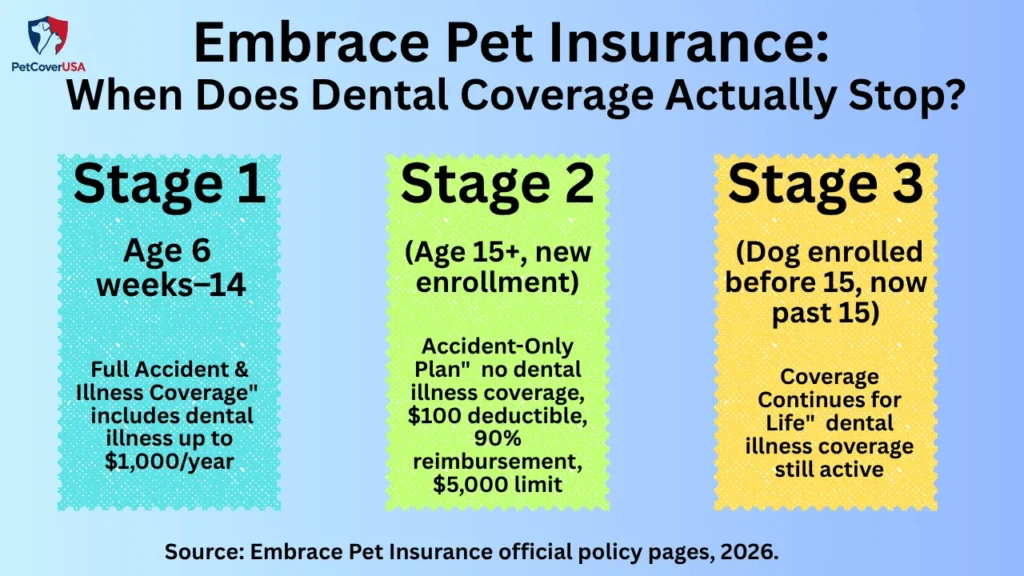
Dogs are eligible to sign up for Embrace’s total accident-and-illness plan (which means they get dental illness coverage too) until they turn 14. Once they turn 15, only the accident-only insurance plan is offered, and this plan will not provide coverage for dental illnesses.
The accident-only plan for dogs that are 15 years old and older has inflexible terms: a $100 deductible, 90% reimbursement, and a $5,000 limit on claims that can be made within the year.
Source: U.S. News — Embrace Pet Insurance Review 2026
If your dog is covered by the full insurance plan even before he or she turns 15, you don’t lose dental illness coverage automatically upon turning 15 as long as the policy remains in place.
Source: Hepper — Embrace Pet Insurance Review 2026
Waiting Periods and Pre-Existing Conditions
Illness cover, including dental illness, comes with a waiting period of 14 days from the start of your coverage. Orthopedic conditions have a longer waiting period of 6 months; however, this can be reduced in certain circumstances with a qualifying vet exam.
Source: U.S. News — Embrace Pet Insurance Review 2026
It is important to know that pre-existing medical conditions will not be covered. Pre-existing conditions are considered to be any illness with symptoms and/or that has been diagnosed before the start of the insurance policy.
Curable pre-existing conditions can be evaluated for coverage after a period of 12 months with no symptoms or treatment.
Cost Section: What a Real Senior Dental Claim Can Look Like
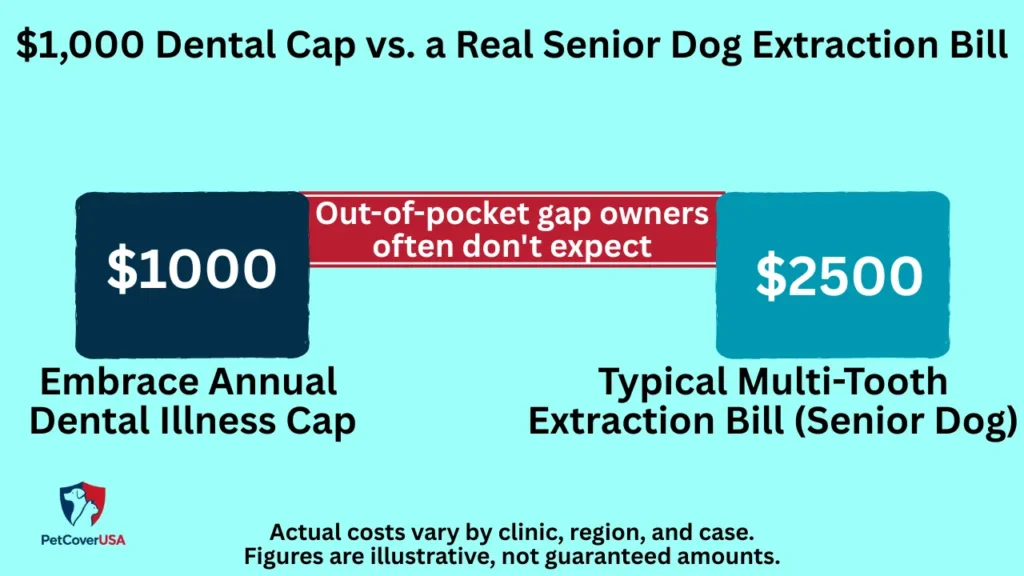
A realistic senior-dental claim can grow costly when anesthesia, imaging, and multiple extraction charges are taken into account. This is why the $1,000 annual dental illness cap is important: it may still be helpful, but it may not cover a complicated dental case in total.
A straightforward example illustrates this. Suppose a dog incurs a $2,500 dental bill, and the policy caps the dental illness benefit; the cap becomes the deciding element, no matter how favorable the deductible and reimbursement percentage may appear.
Claims Section: What the Process Involves and What Owners Report
For claims processing purposes (including the optional Medical History Review), Embrace needs copies of the medical records of your pet from all the veterinary practices you have taken them to during the past 12 months before policy commencement.
Source: Embrace Coverage FAQ
If your claim is denied, you will need to appeal the decision within 60 days of denial by mail, fax, or email. Your veterinarian can also provide supporting documents or present their case if they disagree with the denial decision.
Source: NerdWallet — Embrace Pet Insurance Review
Public sentiment on Reddit is divided: many users report that claims were paid out without hassle, while a small contingent have complaints about claim denials based on pre-existing conditions and premium hikes upon renewal.
Hidden Exclusions Worth Checking Before You Enroll a Senior Dog
The policy for accidents and illnesses from Embrace has exclusions for pre-existing conditions. Only some conditions that can be treated are this policy excludes non-medical things like breeding or pregnancies, attractiveness procedures, DNA testing, wellness treatments, or diets and medicines that aren’t included in wellness add-ons.
In these instances, a rule on bilateral conditions can be used; however, it is still not obvious how to apply this systemic idea to dental problems. Thus, in case of one-sided dental health issues being already registered for a dog, explaining it in writing is a good idea.
Embrace vs. ASPCA vs. Healthy Paws for an Older Dog’s Dental Coverage
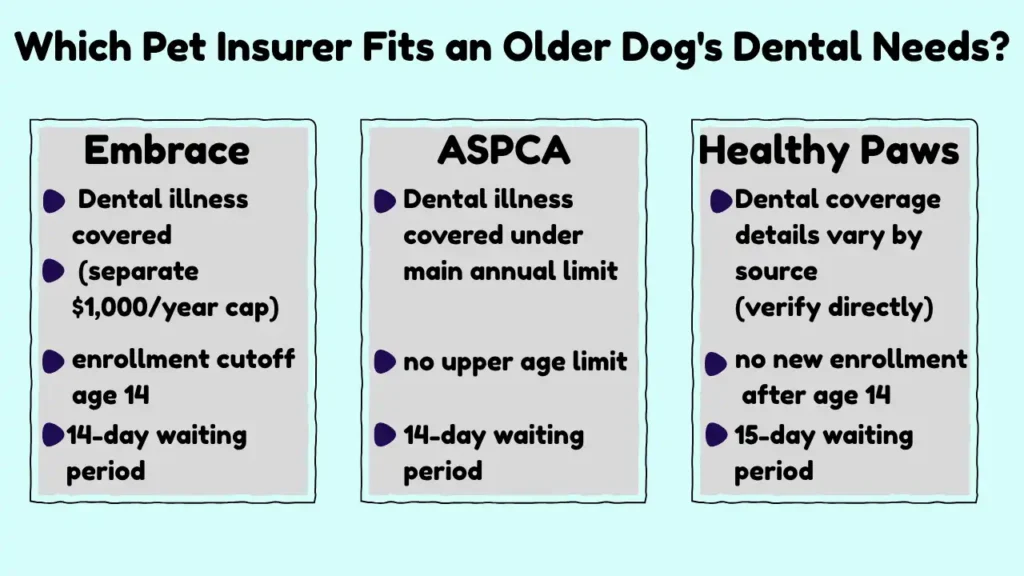
| Feature | Embrace | ASPCA | Healthy Paws |
|---|---|---|---|
| Dental illness coverage | Covered under accident & illness, capped at $1,000/year separately from the overall annual limit | Covered under Complete Coverage as part of the overall annual limit (no separate dental sub-limit found in public materials) | Sources conflict — see note below |
| Routine cleaning | Not covered by insurance; available via optional Wellness Rewards | Not covered by base plan; available via optional Preventive Care add-on | Not covered; no preventive/wellness add-on offered |
| New enrollment age cutoff (dogs) | Full coverage up to age 14; 15+ gets accident-only only | No upper age limit | No new enrollment after age 14 |
| Illness waiting period | 14 days | 14 days (waivable with a vet exam within 14 days of enrollment) | 15 days |
| Deductible range | $100–$1,000 | $100, $250, $500 | $100–$1,000 |
| Reimbursement | 70%, 80%, 90% | 70%, 80%, 90% | 50%–90% |
| Annual limit | ~$2,000–$5,000 up to unlimited (varies by state) | $3,000, $5,000, $7,000 | Unlimited |
Sources: NerdWallet — Embrace · Bankrate — Embrace · NerdWallet — ASPCA · ASPCA Dental Coverage page · Compare.com — Healthy Paws · NerdWallet — Healthy Paws
The comparison chart is quite useful, but there are a few rows that should be treated as summaries instead of universal policy promises. Age restrictions, accident coverage terms, and Healthy Paws dental wording should be handled carefully, as review sites do not always use the same wording as the insurer in their jurisdiction.
In order to ensure the most accuracy of the comparison table, it is important to keep the table intact, but also add a brief note to indicate that the users should check state-specific terms directly with the insurer. This will make the table more trustworthy and also protect the publisher of the content.
Pros and Cons Recap
Pros:
Embrace does seem to include dental illness coverage, which is a plus since some companies offer coverage mainly for dental injuries. The first positive point is that coverage existing before 15 years of age may stay for the rest of their life, ensuring peace of mind to many pet parents in case they sign up for coverage at a young age.
The second good thing about the Embrace policy is the curable pre-existing condition rule so that if the dog has spent a certain time without being symptomatic, it may become eligible again. For senior pet owners, these three points are the key advantages of the program to be discussed.
Cons:
The main disadvantage is that the annual dental illness cap is $1,000, which can prove insufficient in case their pet needs several extractions. The other point is that the older the dog gets. the fewer chances of getting fully covered exist.
The third downside to mention is that the review of the medical history does not happen automatically; therefore, some exclusions will become evident only later. Thus, for a cautious payer, the conclusion can be made that the policy is helpful provided that the medical history is reviewed beforehand.
Alternatives to Consider
If your dog is already 15 years old or older and you haven’t insured him yet, it’s definitely a good idea to look at PetsBest and applications like ASPCA. Neither of these companies has a maximum age limit on registration, unlike Embrace.
Source: NerdWallet — ASPCA Review, Compare.com — Healthy Paws Review
Pets Best is another company that has no age limit on accident and illness registration.
Source: U.S. News — Embrace vs. Pets Best
Decision Framework
If you have a dog that is younger than 15 years old and doesn’t show any signs of dental disease yet, acting fast makes sense in this case. The sooner you register your dog the more chances you have to avoid having to treat its future dental problem as a pre-existing condition.
In case your dog is already 15 years old or older, you will probably want to think about comparing Embrace and other companies because you can’t really be sure whether the dental issue will be covered by some other insurance company. At this point, the right question is not just who is cheaper, but who is more forgiving and better in the question of elder dog compensation.
FAQ’s
Does Embrace cover dental extractions in older dogs?
Yes. Dental extractions caused by a covered illness or accident may be reimbursed up to $1,000 per policy year under Embrace’s dental illness benefit. Your dog must have been enrolled in the accident and illness plan before turning 15, and the dental condition must not be pre-existing.
What happens to my dog’s dental coverage after age 15?
If your dog was enrolled in Embrace’s accident and illness plan before turning 15, dental coverage can continue. Dogs enrolling for the first time at age 15 or older are generally limited to accident-only coverage.
Is periodontal disease considered a curable pre-existing condition?
Curable pre-existing conditions may become eligible again after 12 consecutive symptom-free months. However, periodontal disease is generally chronic and progressive, so it rarely qualifies under this rule.
Does Embrace pay for bloodwork before a senior dog’s dental procedure?
Embrace does not publicly specify whether pre-anesthetic bloodwork is covered. Contact Embrace directly to confirm how this expense is handled under your policy.
Can Embrace deny a dental claim after years of paying premiums?
Yes. If the condition is determined to be pre-existing, a claim may still be denied even after years of paid premiums. Embrace offers an optional medical history review that may identify exclusions before you submit a claim.
How long is the waiting period for Embrace dental illness coverage?
The waiting period is 14 days from your policy’s effective date, which is the same waiting period that applies to most illness coverage under Embrace pet insurance.
Final verdict
Embrace’s coverage for dental problems can be really useful for older dogs who need procedures like tooth extraction or periodontal disease treatment, but the effectiveness of the plan varies based on the age of the dog and the past medical treatments given to the dog. Having a $1,000 limit is also not the only thing to consider; the age of the dog at the time of enrollment and the existing medical conditions of the dog must also be kept in mind when thinking of purchasing the policy.
The best course of action for pet owners would be to examine their pet’s vet history for the last 12 months, apply for a Medical history, if applicable, and get a quote from one more insurer before making the decision.
Related Pet Insurance Guides
If you’re researching dental coverage for your dog, our guide to pet insurance that covers dental care for dogs provides a broader look at dental-related benefits.
Cost can also play a major role when comparing dental coverage. See our guide to affordable dog dental plans in the USA for more information.
If you’re specifically interested in coverage without a waiting period, read our guide to pet dental insurance with no waiting period .
For practical prevention and routine care, see our dog dental care tips for healthy teeth .
For a broader understanding of pet insurance beyond dental care, explore our guide to comprehensive pet insurance coverage .
📅 Last Updated:

About the Author
M. Nouman is an independent researcher and writer focused on U.S. pet insurance. He reviews insurer policy documents, coverage terms, waiting periods, reimbursement options, exclusions, and publicly available veterinary and regulatory resources to create clear, research-based guides. His goal is to simplify complex insurance information so pet owners can make informed decisions based on reliable sources rather than marketing claims. Articles are reviewed and updated as policies and industry information change.
Areas of Research: Pet Insurance Policies, Coverage Analysis, Policy Comparisons, Waiting Periods, Reimbursement Models, Policy Exclusions, Claims Education
Research insights and updates on Quora, LinkedIn, and Reddit.