
Some links may be affiliate links. We may earn a small commission at no extra cost to you.
Information may change over time and should be verified with official providers. We are not responsible for any decisions made based on this content.
Pet Insurance With No Waiting Period in USA: The Complete 2026 Guide
To sum up, waiting periods before the coverage of illness can begin under pet insurance differ from each other. Some companies use shorter waiting periods while others may start covering for emergencies from day one. There are many policies that follow a waiting period of two weeks, but it usually depends on the company, the plan, and the state.
Having checked the policies of more than 20 pet insurance providers the concern is not so much about the waiting period itself. The problem comes up when certain symptoms that were present during the waiting period can be treated as pre-existing.
This guide will help you learn about pet insurance waiting periods, how to shorten them, and what factors you should take into consideration before applying for insurance.
- Why I Wrote This (And Why It’s Different)
- What Is a Pet Insurance Waiting Period? (And Why It Actually Exists)
- The Trupanion Exam Day Offer: Same-Day Coverage Most People Never Hear About
- 4 Ways to Reduce or Avoid a Waiting-Period Problem
- The Pre-Existing Condition Thing
- Deep Research Comparison: MetLife Pet vs. Lemonade vs. Trupanion
- What You’re Actually Risking During a Waiting Period (In Real Numbers)
- The 180-Day Pre-Existing Condition Reset: How to Use It in Your Favor
- Which Breeds Need the Shortest Orthopedic Waiting Period (And Which Carrier to Choose)
- When “No Waiting Period” Doesn’t Mean What You Think
- FAQs About Pet Insurance With No Waiting Period in USA
- My Final Take
Why I Wrote This (And Why It’s Different)
When it comes to pet insurance, there can be a lot of confusion surrounding waiting periods since different providers have separate regulations. To compile this guide, I researched public policy documents, insurance providers, industry information, and consumer experiences.
The problem is that waiting periods can be long. Conditions that existed prior to insurance kicking in can influence the outcome of any claims made later in the policy. Some companies may even have rules about waiting period exemptions provided the client meets certain requirements.
This information is provided here in an easy-to-understand way for those searching for pet insurance for their first puppy, their rescue dog, or their existing pet. Since policies vary between companies and states, it is important to read the fine print.
What Is a Pet Insurance Waiting Period? (And Why It Actually Exists)
Waiting periods refer to the period which commences from the effective date of your policy registration until the time when coverage can commence. Insurance companies tend not to pay out claims for sickness or injury that occurs during the waiting period. In the case that symptoms emerge during the waiting period, the insurance company may classify them as pre-existing, depending on the insurance policy, state and plan.
There is a reason why waiting periods exist for pet insurance that does not compensate for current conditions because pet insurance only covers the loss of future costs. According to Dr. Ricky Walther from the Pawlicy Advisor, pet insurance allows protection against unexpected financial losses. Source: AAHA
Pet insurance is very different from human medical insurance. Financial repossession depends upon various aspects like excess amount, reimbursement percentage, upper limit for reimbursement and exclusions within the policy itself.
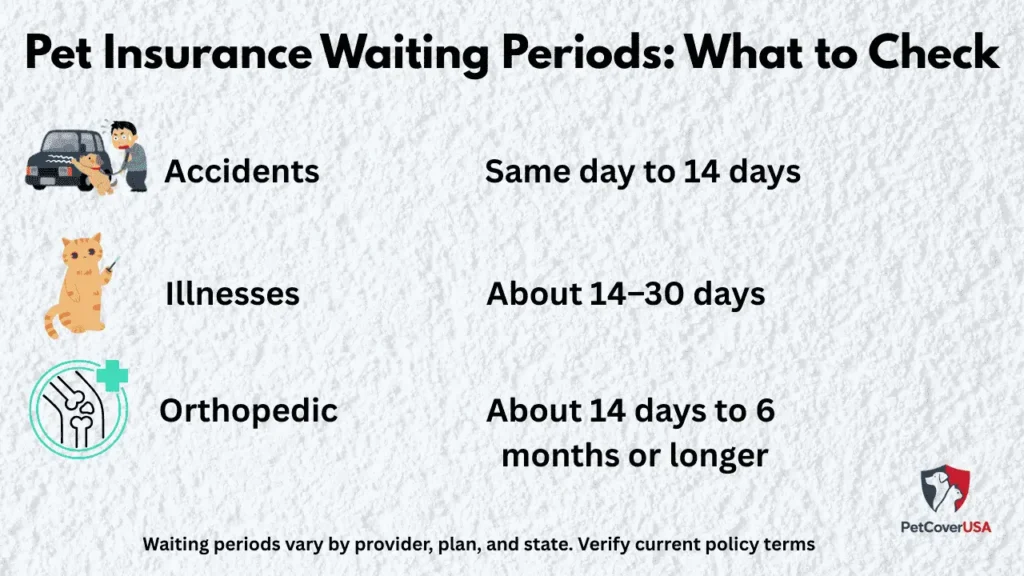
The Real Waiting Period Breakdown in 2026
| Coverage | Typical waiting period (varies by provider/state) |
|---|---|
| Accidents | Same day to 14 days |
| Illnesses | About 14–30 days |
| Orthopedic conditions | About 14 days to 6 months or longer |
| Wellness care | Often no traditional waiting period |
| Hip dysplasia | Provider- and state-specific |
As an example, Embrace has a 14-day illness waiting period, but orthopedic coverage waiting periods vary by state and veterinary examination.
Orthopedic coverage is particularly important for dog breeds that have a higher likelihood of joint or ligament problems. Of course, risk is only a factor in your claim approval when the policy waiting periods, provisions, and exclusions have been met. Be sure to review the most up-to-date policy documents before purchasing the insurance.
The Trupanion Exam Day Offer: Same-Day Coverage Most People Never Hear About
Trupanion’s Exam Day Offer may provide instant pet insurance coverage after an eligible vet visit at a participating veterinary clinic. The offer needs to be activated within 24 hours following the visit, and the offer duration lasts for 30 days following activation.
Trupanion states that the offer includes 90% coverage for new and unforeseen injuries and illnesses within the terms of the policy. It may also cover hereditary as well as congenital conditions, tests, surgeries, and medications. The policy clarifies that there is no lifetime payout limit (per policy terms) for covered conditions during the lifetime of the pet.
Generally, an eligible dog or cat should be under 14 years of age. There are neither upfront expenses nor payment details required to activate the offer, and coverage will be automatically terminated after 30 days if the pet owner does not opt for a paid policy. However, the eligibility, exclusions, deductibles, and terms apply.
Source: Trupanion.com
If you have an appointment with a vet soon, check whether the clinic takes part in Trupanion’s Exam Day Offer. Don’t think of it as “free insurance” or the only same-day offer available in the U.S.
4 Ways to Reduce or Avoid a Waiting-Period Problem
Ask about a veterinary exam waiver
Some insurance companies may actually waive or reduce the waiting period for an orthopaedic condition if the exam was carried out prior to taking out the policy. For example, in the case of Pets Best, the exam must actually have taken place in the period of within a defined window around the policy start date (per current policy terms) the start date of the insurance, and the documents must be submitted within 30 days. Source: PetsBest.com
Compare switching offers carefully
Some insurance companies may actually waive part of the waiting time for an illness if you’re switching from another policy. The terms of whether this is true or not depend on the company; so it’s better to find out if your offer is valid in writing before you cancel your existing policy.
Check employer-sponsored options
If you’re eligible, it’s possible to maintain a MetLife insurance plan that may provide coverage for some medical conditions that have been covered by another insurance company previously, only if there is no break with the previous insurance. However, not all MetLife plans apply such a rule. Source: MetLifePet.com
Ask shelters about enrollment benefits
Some shelters, rescues, or insurance companies provide special programs for newly adopted animals. Make sure which organization is participating and all necessary steps before relying on this offer.
Before buying an insurance policy, make sure to talk to the insurance company about whether there are any waivers of the waiting period, under what conditions it operates, and when you will be able to apply for insurance.
Prior to Cancelling Your Current Policy
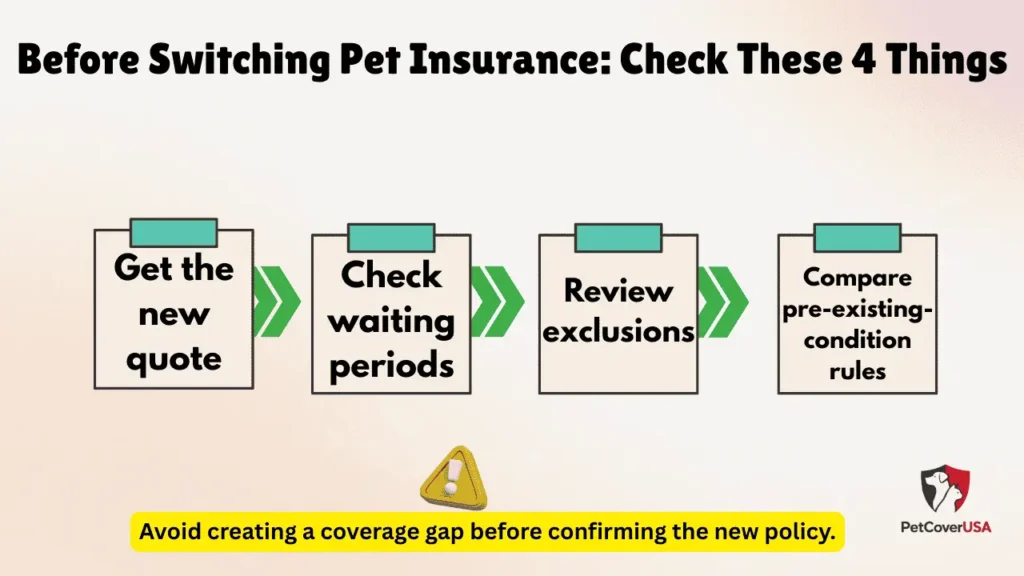
Do not cancel your current insurance policy if you intend to change insurers. First, get the contract terms for the new insurance policy and understand how long you will need to wait for it to go into effect, which exclusions you will need to abide by, and what limits will be imposed regarding pre-existing health conditions.
Having a break in insurance can affect how the next insurance company views your animal’s health record. It is prudent to compare policies before making a switch.
The Pre-Existing Condition Thing
Symptoms Can Matter
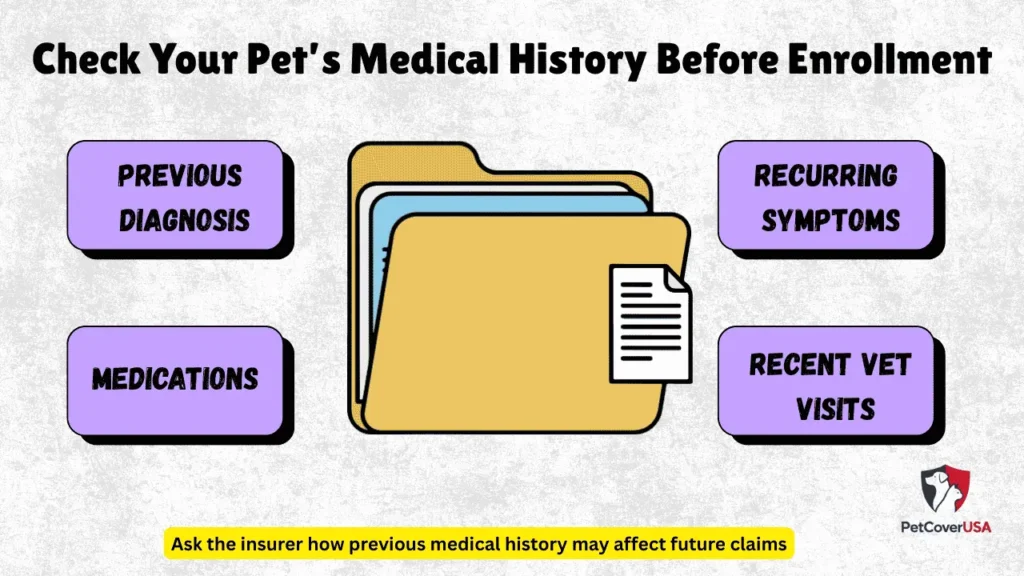
Insurance companies may check your pet’s health history for any problems that existed before enrollment or during the waiting period. Even if your pet never received an official diagnosis, things like limping, recurrent ear infections, or intestinal issues may affect your future claims.
Before purchasing a policy, you should obtain your pet’s health records and check with the insurance company to see how any previously occurring issues will affect your claims.
Bilateral Conditions
Bilateral conditions refer to situations in which both parts of a paired body part, such as knees, hips, or eyes, have problems. In case one part had a problem before the policy began, the issue with the other part may not be covered by some policies. According to MetLife, however, bilateral coverage may be available when the pet’s medical records do not prove that the other part was previously affected.
Think Before Cancelling
Lemonade points out that renegotiating and submitting a fresh application could alter the waiting time and may also broaden the definition of pre-existing conditions. As long as you retain the same policy, the waiting period typically is not active again at renewal.
Practical tip: Before changing your insurer, it’s worthwhile to get a quote from the new one and compare it to the waiting period and eligibility for coverage terms for pre-existing conditions.
An Easy Medical History Review
Collect your pet’s recently vet records, tests, drugs, and notes of previously repeated problems before you register for your insurance.
After that, inquire with the insurance company regarding how these records will influence your possible claims. Understanding how the records will affect your claims when you enroll will help you prevent surprises after purchasing an insurance plan.
Deep Research Comparison: MetLife Pet vs. Lemonade vs. Trupanion
| Feature | MetLife Pet | Lemonade Pet | Trupanion |
|---|---|---|---|
| Accident waiting period | Often 0 days for accidents (policy/state-specific) | Check current policy and state terms | Immediate only under eligible Exam Day Offer |
| Illness waiting period | 14 days | 14 days | Depends on policy; Exam Day Offer may waive waiting periods |
| Orthopedic waiting period | Policy/state-specific | 30 days listed by Lemonade | Offer-specific; verify policy terms |
| Orthopedic waiver | Not confirmed as a general benefit | Not listed as a general benefit | Exam Day Offer may waive waiting periods |
| Pre-existing-condition transfer | Possible through eligible employer group plans | New enrollment rules apply | Offer and policy terms apply |
| Bilateral conditions | May be covered if the other side was not previously affected | Policy-specific exclusions apply | Check policy wording |
| Reimbursement | Choose from available policy options | Choose from available policy options | 90% under Exam Day Offer |
| Annual limit | Selectable, subject to plan | Selectable, subject to plan | No lifetime payout limit for covered conditions under the offer (per policy terms) |
| Preventive care | Optional add-on | Optional package; no waiting period for listed benefits | Not included in the standard offer |
| Same-day option | Accident coverage starts on effective date | Confirm current policy terms | Exam Day Offer through participating clinics |
| Renewal waiting periods | Check policy terms | Do not normally repeat while policy remains active | Check policy terms |
According to the official website of MetLife, accident insurance and optional preventive care coverage start at the time of insurance initiation, while illness insurance coverage will start after a period of 14 days. The website also states that employer-sponsored conversion may allow coverage for pre-existing health conditions based on the conditions. MetLife Pet Insurance
As per the details that are mentioned on Lemonade’s website, the illness insurance waiting period is 14 days and 30 days in case of orthopedic conditions. The website also mentions that preventive care benefit will be available the day after purchase. Lemonade
Trupanion has come up with its Exam Day Offer, where the policyholder will get immediate coverage on activation, and the activation should be completed within 24 hours of the exam, and it provides 90% coverage for the covered disease without a limit on claim amount. Trupanion
How to Utilize This Comparison Table
This table should be viewed as a point of reference instead of a decisive choice. Insurance terms may differ depending on the state policy, plan, pet, and date of entering into the agreement.
Look at the current policy documents before buying the insurance policy and check the waiting period, deductible, reimbursement, exclusions, and eligibility requirements in connection to your quote.
What You’re Actually Risking During a Waiting Period (In Real Numbers)
If your pet needs urgent treatment before your plan kicks in, being “out of pocket” could be expensive. According to MetLife, emergency treatment can be as high as $5,000 for dogs and $3,000 for cats. MetLife cites average monthly premiums of around $52 per month for dogs and $28 per month for cats for 2026. However, the exact costs can vary based on the type of animal, location, type of plan, and type of coverage chosen. MetLife Pet Insurance
| Example | Possible expense |
|---|---|
| Emergency veterinary care | Up to $3,000+ for cats and $5,000+ for dogs |
| Emergency surgery or hospitalization | Often thousands of dollars |
| Severe poisoning, obstruction, or infection | Cost varies by treatment and length of care |
A 14-day illness waiting period implies that any sickness contracted within that time may not be covered. It can also influence future coverage in case the insurance provider regards any resulting illness as pre-existing. The effect will depend on the conditions of the policy, the location, medical history of the patient, the deductible, the reimbursement rate, and other exclusions.
According to Trupanion, Trupanion reports that up to 50% of puppies may experience an injury or illness in their first year from some kind of injury or illness within their first year. This makes you realize how important it is to sign up for insurance beforehand, as there is data from the insurer, but nothing guarantees that the puppy will require any treatment. Trupanion
The 180-Day Pre-Existing Condition Reset: How to Use It in Your Favor
Depending on the terms of your policy, major insurers may remove pre-existing condition exclusions, provided that the specific condition does not recur within a specific time that follows enrollment.
| Carrier | Typical reset period (symptom- and treatment-free) | Common non-resetting exclusions |
|---|---|---|
| ASPCA | 180 days | Knee/ligament conditions |
| Spot Pet Insurance | 180 days | Knee/ligament conditions |
| ManyPets | 18 months | Hip dysplasia, cruciate, IVDD |
| Figo | 12 months | Cancer, bone/joint, diabetes, allergies |
| USAA (Embrace underwriting) | 12 months | Standard exclusions apply |
Sources: ASPCA Pet Insurance, ManyPets, and Best Money.
If your dog has had ear and/or respiratory infections before enrolling in a policy, it is worthwhile to apply for a pet insurance product with a 180-day reset period. You must remember to keep track of the 180-day window.
When your pet continues to be symptom-free or not in need of treatment during the reset period, the treated condition may be eligible for coverage under the policy. This is not a catch; rather, it is how some insurance policies have been structured.
Questions to consider
If an insurance company states “immediate” or “no waiting period” coverage, you should inquire:
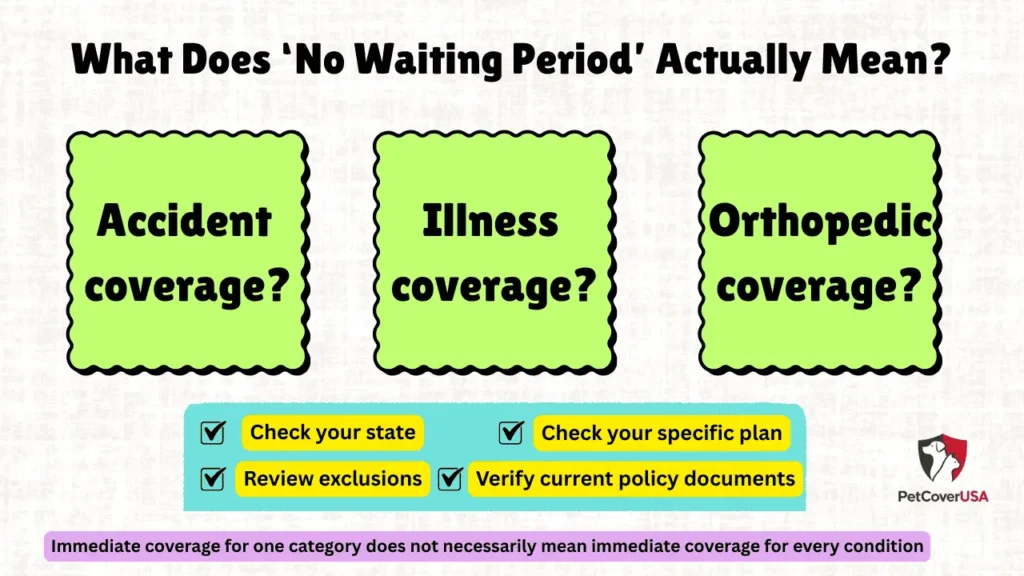
- Is this for accidents, illnesses, or both?
- Does it apply to my specific plan and state?
- Are there exclusions or eligibility criteria?
Finding out the answers in writing can help the comparison process immensely.
Which Breeds Need the Shortest Orthopedic Waiting Period (And Which Carrier to Choose)
Your pet’s breed can influence which insurer makes the most sense, especially around orthopedic coverage timelines.
| Breed | Primary orthopedic risk | Average treatment cost | Carrier option with shorter ortho timeline (verify current terms) |
|---|---|---|---|
| Labrador Retriever | Cruciate ligament, hip dysplasia | $4,000–$7,000 | Embrace (14-day waiver with exam) |
| German Shepherd | Hip and elbow dysplasia | $3,500–$6,000 | Embrace or Pets Best (waiver available) |
| French Bulldog | IVDD, patellar luxation | $3,000–$8,000 | MetLife (no separate ortho period) |
| Golden Retriever | Cruciate, hip dysplasia | $4,000–$7,500 | Embrace (14-day waiver with exam) |
| Dachshund | IVDD | $2,500–$5,000 | MetLife (no separate ortho period) |
MetLife Pet typically implements a 14-day illness period for many orthopedic conditions (no separate orthopedic waiting period exists in many states). Therefore, for some high-risk breeds, this type of plan is more advantageous than plans that impose a 6-month orthopedic waiting period.
Check local policy specifications before enrolling.
When “No Waiting Period” Doesn’t Mean What You Think
This phrase is used in such a way during marketing that it can be easy to misunderstand. Here is a breakdown in simple language:
“Coverage starts the day after enrollment.”
This is typically true only for accidents, not for illnesses. Always ask your insurer what it means for your illness waiting period specifically.
“Immediate coverage available”
It usually refers to same-day options like Trupanion’s Exam Day Offer or to wellness add-ons. Your core accident and illness insurance policy still has a standard wait.
“No waiting period for preventive care”
It is accurate for most carriers, but preventive care (annual exams, vaccines) is a small fraction of what you’d actually claim. The real money is in accidents and illnesses.
“Zero-day waiting period”
MetLife’s 0-day accident coverage is legitimate and verifiable. Illness still has a 14-day wait.
My rule whenever you read a marketing advertisement: you should ask three separate questions: what is my waiting period for accident, what is my illness waiting period, and what is my orthopedic waiting period? They almost always have three different answers.
How to Compare Waiting Periods
Don’t compare waiting periods by looking at a single number. Instead, check waiting periods for injuries, illness, and orthopedic issues since they might differ even with the same insurance. When comparing different quotes, lay out each quote, lining up each period. This will let you easily compare whether a lower-priced plan truly provides the waiting period terms that you desire.
❓ FAQs About Pet Insurance With No Waiting Period in USA
Can I get pet insurance with absolutely no waiting period for illnesses?
What will happen if my pet gets sick during the waiting period?
Will the waiting period reset when I renew my policy?
Source: NerdWallet — https://www.nerdwallet.com/insurance/pet/learn/pet-insurance-waiting-periods
Is accident-only coverage a good workaround for the waiting period?
Can I have two pet insurance policies at the same time?
What’s the fastest legitimate way to get full coverage right now?
My Final Take
Based on my analysis of policy documents, comparison of insurers, and consumer experience reports, here’s how I would advise a close friend around pet insurance.
Get your pet insured as soon as you take it home. Do not wait a week or until the first vet visit. The longer you wait, the more time there is for a new medical condition to become permanent.
If you plan on going to the vet soon, be sure to inquire about the Trupanion Exam Day Offer as you leave the vet clinic. This is one of the rare opportunities for same-day coverage in the U.S. and it is free.
If your pet belongs to a high-risk breed (e.g., Labrador, French Bulldog, German Shepherd), it is wise to choose an insurer that has a shorter orthopedic waiting period or one that has waiver options available.
Avoid choosing the cheapest monthly premium just because it is the cheapest option. In most cases, choosing a low monthly premium could mean that an $8,000 surgery will not be financed by the insurance.
You should not cancel new policies unnecessarily and return to old ones. This mistake might cost owners a lot of money.
The U.S. pet insurance market generated over $4.7 billion in gross written premiums in 2024, a 21.4% increase from 2023, yet fewer than 4% of U.S. pets are insured. That gap exists largely because many owners don’t know where to start or misunderstand the fine print.
Now you do.
Sources: Lancaster Puppies, 6 Key US Pet Insurance Statistics 2025
AAHA Pet Insurance Insights 2025
Information on this page is based on publicly available policy details, insurer documentation, and general research as of the time of writing. Coverage terms, waiting periods, and pricing may vary by provider and can change over time. Readers should confirm the latest policy details directly with the insurer before making any decision.
Related Pet Insurance Guides
If you’re comparing policies based on when coverage begins, our guide to comprehensive pet insurance coverage can help you understand the broader features to compare.
Waiting periods are only one part of policy terms. It’s also important to understand exclusions, including how pet insurance handles pre-existing conditions .
If keeping premiums affordable is important, see our guide to affordable pet insurance plans for dogs and cats before choosing a policy.
You can also compare provider-specific options through our Lemonade pet insurance review .
Another provider to consider during your research is covered in our Embrace pet insurance review .
📅 Last Updated:

About the Author
M. Nouman is an independent researcher and writer focused on U.S. pet insurance. He reviews insurer policy documents, coverage terms, waiting periods, reimbursement options, exclusions, and publicly available veterinary and regulatory resources to create clear, research-based guides. His goal is to simplify complex insurance information so pet owners can make informed decisions based on reliable sources rather than marketing claims. Articles are reviewed and updated as policies and industry information change.
Areas of Research: Pet Insurance Policies, Coverage Analysis, Policy Comparisons, Waiting Periods, Reimbursement Models, Policy Exclusions, Claims Education