
Some links may be affiliate links. We may earn a small commission at no extra cost to you.
Information may change over time and should be verified with official providers. We are not responsible for any decisions made based on this content.
Embrace Pet Insurance Review 2026: Key Things to Know Before Buying
Selecting a pet insurance policy involves more than simply determining how much you can afford to pay. It is essential to understand the definition of coverage as well as what you will have to pay in case a vet provides treatment for your dog or cat. You should also take your pet’s medical history into consideration when applying for pet insurance.
For this Embrace Pet Insurance article, I have come across information provided in the publications of the company, as well as directions on waiting periods, medical history review, and claims application.
I am an independent expert who knows a lot about pet insurance. I am neither an insurance agent nor a veterinarian, and I write my findings in simple terms, so everyone can understand what I have to say.
Important: Insurance coverage depends on the policy wording, state, plan selections, and your pet’s circumstances. Use this review to prepare questions, then confirm the answers in your own quote and policy documents.
- What Is Embrace Pet Insurance?
- Ratings & Research Methodology
- Pros & Cons at a Glance
- What Does Embrace Actually Cover?
- 3 Important Policy Details to Understand
- How Much Does Embrace Really Cost?
- What Real Customers Experience When Filing Claims
- Deep Research Table: Embrace vs. Pets Best vs. ASPCA
- Who Should (and Should Not) Buy Embrace
- Frequently Asked Questions (FAQs)
- Bottom Line: Is Embrace Worth It in 2026?
What Is Embrace Pet Insurance?
Embrace Pet Insurance provides pet insurance policies that help qualifying pet owners deal with some of their veterinary expenses. The accident and illness coverage is meant for relevant treatments that are done as a result of certain injuries or diseases. However, it’s important to note that the policy conditions, limitations, waiver periods, deductible amounts, reimbursement percentage, and yearly cap must all be satisfied.
In general, pet insurance differs from a savings account. Under a pet insurance plan, a pet owner pays a premium to maintain the insurance, and the insurance assesses their expenses according to the terms of the policy. Pet owners may still have to pay some of the veterinary bill.
An illustration of this would be: when your pet requires treatment due to the accidental ingestion of a foreign item, you have to bear in mind that not all related expenditures would be automatically compensated. The insurance company will need to assess the diagnosis, medical documentation, date of insurance, and relevant limitations.
Before finalizing your purchase, request a price estimate and insurance documents that will apply to your area from Embrace. Make sure to go beyond just the premium and identify the deductible, percentage of reimbursement, yearly limits, exclusions, and the beginning of coverage.
Official source: Embrace Pet Insurance Coverage FAQs
What Does Embrace Pet Insurance Cover?
The company Embrace provides coverage for various types of accidents and illnesses. Whether a specific treatment and costs can be reimbursed is subject to the particular plan and policy offered.
The examples below can be used to verify coverage but do not guarantee approval for payment of any particular claim.
Accidents and injuries
An accident and illness plan may help with eligible veterinary treatment for covered injuries. Examples to ask about include:
- Injuries caused by an accident.
- Swallowed foreign objects.
- Broken bones.
- Wounds that require veterinary treatment.
Do not rely on a general list alone. Ask whether the specific diagnosis, treatment, diagnostic tests, medication, and related fees are eligible under the policy you are considering.
Illnesses
Accident and illness coverage may include eligible treatment for covered diseases and other medical conditions.
Examples worth checking include:
- Infections.
- Digestive problems.
- Certain chronic illnesses.
- Diagnostic testing related to a covered condition.
- Prescription medication when eligible under the policy.
A condition appearing on a general coverage list does not mean every case will qualify. The pet’s medical history, waiting periods, exclusions, and policy wording may affect the outcome.
Dental treatment
Dental insurance might appear confusing, as normal dental services and treatment of a dental issue can be treated differently.
Prior to signing up, ask questions regarding dental disease coverage, essential dental procedures, and the distinction between preventative services and treatment of a dental problem. Get the actual policy wording and not merely a short statement presented on the quote page.
Wellness and routine care
It is not reasonable to think that a regular accident and illness insurance policy provides coverage for every typical expense, including yearly physicals, vaccines, or preventive treatment.
Embrace also has another offering called Wellness Rewards, which is not very similar to accident and illness insurance.
Practical steps: compile a list of expected veterinary expenses for the upcoming year. Compare every expense against the specific policy under consideration. This will be more useful than just choosing a policy according to a perception of its long list of covered expenses.
Official sources:
What Does Embrace Pet Insurance Not Cover?
The answer is contingent upon the policy under consideration; however, there is one thing that each purchaser has to keep in mind: pet insurance does not cover all conditions or veterinary bills.
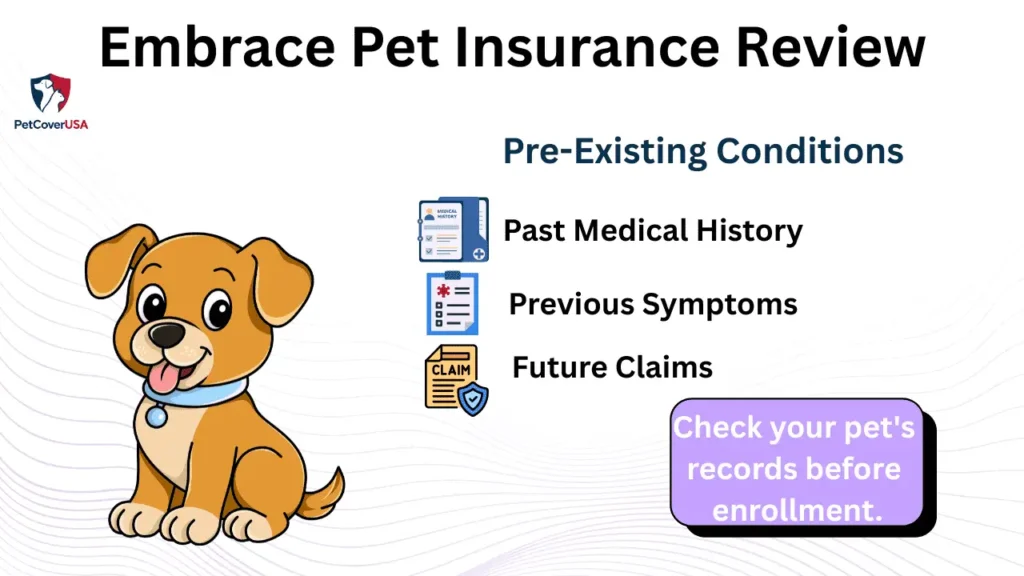
Pre-existing conditions
The relevant symptoms or medical history may be regarded as pre-existing when they emerge before the coverage has taken effect or during the waiting period. The evaluation of individual situations differs based on the policy in question and a medical record.
According to Embrace, the company differentiates some curable and incurable pre-existing conditions when processing applications. According to their coverage FAQ, some curable conditions become eligible for coverage one year after the symptoms have become absent. However, not all previously diagnosed conditions will end up being covered.
Be sure to read the policy and inquire with Embrace how the rule pertains to your pet’s medical history.
Waiting-period conditions
Having a condition that arises or reveals symptoms during a waiting period may determine whether any future claim is covered. It is critical to read the waiting-period rules and make sure that the definitions given in the policy make sense in conjunction with the important dates.
Other exclusions and limitations
The policy may provide for other exclusions, restrictions, or limits. Just because a treatment is necessary does not automatically imply that it will be reimbursed.
Before enrolling, read the policy’s exclusions and definitions. If something is unclear, ask the insurer to explain it in writing along with specifying the relevant section.
Official sources:
Embrace Waiting Periods Explained
The waiting period can be described as the duration at the beginning of a policy when certain coverage is not fully available. The act of acquiring any insurance policy does not automatically mean that all kinds of treatments will be entitled to reimbursement.
As of now, the waiting period for sickness for the Embrace company is stated to be 14 days, while specific waiting periods for orthopedic conditions may differ depending on the particular US state. Customers should check their own accounts to find what the actual start of coverage is.
This does not mean every waiting period is the same regardless of the particular kind of condition.
How to check your waiting periods
- Review the waiting-period information for your state.
- Find the effective date of your policy.
- Check the separate coverage start dates shown in your Embrace account.
- Ask the insurer to clarify any accident or orthopedic waiting-period rule that is unclear.
- Save the answer and the relevant policy document.
This is important because a symptom arising before the relevant coverage begins can impact a future claim. Don’t delay the needed veterinary care if your pet has any symptom or health problem in order to get insurance coverage.
Important note: This article does not provide any general number as to the accident waiting period. Verify what is stated in the quote or the policy itself, instead of relying on the estimate of a third party that might be referring to some different version of the policy.
Official source: What Waiting Periods Does Embrace Have?
Pre-Existing Conditions and Medical History Review
This is one of the vital steps for pet owners to compare pet insurance plans.
Let’s say you had a dog with an ear infection before you decided to get pet insurance. Some months later, the dog experiences another ear problem. Would you want to know whether this will be covered by insurance?
Knowing the name of the diagnosis is insufficient. You will have to consider other factors like the timing, medical notes, symptoms, the policy definition, any rules that apply, and certain other considerations that may matter to the insurance company.
Why your pet’s records matter
Veterinary records may include information relating to symptoms, examination results, test results, and prior diagnoses. This data can assist the insurer in determining whether a certain condition is pre-existing as per the terms of the insurance policy.
Embrace claims that its medical history assessment can determine the presence of pre-existing conditions and specify the duration of these conditions. This service is optional and needs to be applied for.
How to request an Embrace medical history review
According to Embrace’s published instructions:
- Enroll your pet before requesting the review.
- Email your request to askclaims@embracepetinsurance.com.
- Follow the instructions for providing the required veterinary records.
- Keep the review results and any follow-up correspondence.
- Ask questions about any condition or exclusion you do not understand.
According to Embrace, a comprehensive report of the pet’s veterinary records covering the time period of 12 months prior to the start of the policy is always needed. When dealing with pets that have only recently joined your family, such as puppies or kittens, please be advised that the requirements might be different. The insurance company stresses that you cannot just provide invoices or summaries of medical history and expect it to be enough for the purpose.
Make sure to check the current official guidelines before providing the documents for the review, as the insurance company decides what documents it requires in this case.
Three illustrative situations to think through
These instances are to help you formulate better questions. They are not indications of how Embrace might adjudicate any claim.
Situation 1: Previously recorded symptom
Your cat had a history of vomiting before taking the policy. After taking the policy, your cat now experiences a different gastrointestinal issue.
Questions to inquire: What is the definition of a pre-existing condition as per the policy? How would the previous medical history impact this claim?
Situation 2: A condition has healed
Your dog had an ear infection, was treated, and stopped showing any symptoms afterward.
Questions to inquire: Is there a curable condition policy? What does the symptom-free term encompass, and how is it measured, including required medical history documentation?
Situation 3: A new diagnosis obtained after enrollment
Your pet has received a diagnosis afterward.
Questions to inquire: Were there any previous symptoms, conditions, or exclusions related to the policy that should be taken into consideration?
The practical value of reviewing medical history early
If your animal has had past medical concerns, inquire about the evaluation of the medical history prior to relying on the policy for future costs. Be sure to go through it thoroughly, save it, and ask about anything you don’t understand in it.
This may not ensure your request will be granted in the future, but it will allow you to assess possible shortcomings before filing a claim.
Official sources:
How Embrace Pet Insurance Claims Work
Having an understanding of what happens during the claims process before any situation occurs will ease your claims paperwork later.
Embrace has made its claim information accessible online and on your account. The insurance firm further states that processing the first claim may take longer than expected, as the company will need to check the medical history of the pet before a decision is made. The length of time taken will depend on how quickly you are able to provide all the necessary information and documents.
A practical claims checklist
Step 1: Keep the complete veterinary invoice.
Save the itemized invoice and any supporting documents. Keep records of the treatment date, diagnosis, and payment.
Step 2: Follow Embrace’s current submission instructions.
Use the official website or app instructions applicable to your account. Check that you have submitted all required information.
Step 3: Keep a record of your submission.
Save the claim reference, submission date, invoice, and any messages from the insurer.
Step 4: Check whether more information is needed.
In case of delay in processing the claim, ensure to find out if the insurance company is waiting for medical records or some information from the vet office or some other document.
Step 5: Review the decision carefully.
If the claim has been processed, it is important to read the Explanation of Benefits or other documents. Check which expenses were deemed eligible, which were not, and how the policy deductible or reimbursement terms were applied.
It is important to note that just because a claim is filed, it does not mean it will be approved. The insurance company has to process it according to the relevant policy.
Official source: Embrace Pet Insurance Claims
What to Do If an Embrace Claim Is Pending or Denied
When your pet needs urgent treatment, waiting for an insurance claim to be approved or denied can be very annoying. The most effective way to proceed is to find out what the insurer’s requirements are for making the decision.
If your claim is pending
Start with these actions:
- Sign in to your Embrace account and check the claim status.
- Look for a request for additional information.
- Contact your veterinary practice if records or test results are outstanding.
- Ask Embrace which specific documents are missing, if any.
- Keep copies of the documents you submit and note the dates.
If you have already provided all that is required, determine if the claim is pending the review of the medical history or some other step in terms of assessment. Ask for specific details about next steps rather than relying on an estimate of processing time.
If your claim is denied or partly reimbursed
Examine the documentation regarding the choice prior to figuring out what your next move should be.
Find the provided reason. This can be a pre-existing condition, exclusion, waiting period, or benefit limit among many other matters.
Then:
- Identify the exact policy clause mentioned in the decision.
- Compare the decision with your policy and the relevant veterinary records.
- Ask Embrace to explain any wording you do not understand.
- If you believe the assessment is incorrect, ask what evidence would help support an appeal.
- Keep all correspondence and check the applicable appeal deadline immediately.
Important: verify the appeal deadline
The guidelines that have been posted by Embrace differ significantly across various mediums. For example, while its claims page suggests that you can appeal within 14 days of a claim decision, the page on the Help Center states that you must file your appeal within 60 days from the policy renewal date. In addition, the Help Center says that the processing time of your appeal depends on the version of your policy.
Since there is a contradiction regarding the deadline, you cannot presume that both of these deadlines apply to your claim. It is a wise idea to read your policy paperwork and reach out to Embrace ahead of time to check which deadline applies to your case. In case the deadlines are fast approaching, you shouldn’t solely depend on an online article written with general information that might not address your specific situation.
As far as the appeal goes, the Help Center indicates that the appeal can be supported with the veterinarian’s letter as well as reasoning in terms of the medical records, laboratory results, and X-rays where necessary.
Official sources:
How Much Does Embrace Pet Insurance Cost?
There is no fixed monthly rate that applies to all dogs and cats. Your quote will depend on things like the specifics about your pet, where you live, and what kind of coverage you select.
Rather than just accepting whatever price you see in an article, go get a price quote for your pet.
Compare more than the monthly premium
When comparing Embrace with another insurer, record these details for each quote:
| What to compare | Why it matters |
|---|---|
| Monthly premium | What you pay to maintain the policy |
| Annual deductible | The amount you may need to pay before reimbursement applies, according to the policy |
| Reimbursement percentage | The share of eligible expenses used in the reimbursement calculation |
| Annual maximum | The policy’s limit on covered benefits during the applicable period |
| Waiting periods | When each relevant type of coverage begins |
| Exclusions | Conditions or expenses the policy does not cover |
| Claims rules | What documentation you need and how decisions can be appealed |
When trying to compare plans, make sure that you compare plans with the same deductible, reimbursement percent, maximum payout, and other key features.
What about a premium increase at renewal?
Do not believe that the price given today will be constant throughout the duration of the policy. If your new premium is higher than the old one, examine the papers for the renewal and inquire about the reasons why the insurance company decided on it.
Obtain new offers and compare them with the revised premium and the scope of coverage before taking a final decision. Just be careful while reading the new papers since they may treat your pet’s medical history and existing conditions differently.
Hint: Keep all the documents related to the quote and the renewal. Comparing them side by side will make your task easier as you will see what exactly changed without having to rely on your memory.
Official sources:
How Pet Insurance Reimbursement Works: An Example
A policy deductible and reimbursement rate can change the final amount you will receive significantly. The example below illustrates the basic maths involved. It’s an educational example only and is not representative of how Embrace will pay certain claims.
Imagine these figures:
- Veterinary bill: $800
- Eligible expenses under the policy: $800
- Remaining deductible: $200
- Reimbursement percentage: 80%
- Other exclusions or adjustments: none in this simplified example
For this illustration, subtract the remaining $200 deductible from the $800 eligible bill:
$800 − $200 = $600
Then apply the 80% reimbursement rate:
$600 × 80% = $480
This example would yield a reimbursement of $480, meaning the pet owner would still have to pay $320 out of pocket.
In reality, claims may be different if some expenses are not eligible, the deductible was partially covered, a limit has been reached, or the policy includes some other type of calculation. It is better to check the reimbursement process directly in your policy.
Try this before choosing a plan
Your insurer will require you to demonstrate how this approach works by giving a real but realistic example of using a veterinarian and asking more specifically how your insurance deductible, reimbursement percentage, and maximum payment amount apply. You should also determine if the remaining amount left after your insurer pays the allowable costs could be paid comfortably by you.
A plan that has a lower price tag will not work well if its deductible and other plan provisions end up maxing out your budget.
Official source: Embrace Coverage FAQs
A Five-Minute Embrace Policy Check Before Buying
This is the most useful step to take before enrolling. Instead of relying only on a review, use the following checklist to inspect the actual policy and identify questions that still need answers.
1. Check your pet’s medical history
- Have there been previous symptoms, diagnoses, injuries, or treatments?
- Are the relevant veterinary records complete?
- Would requesting an Embrace medical history review help clarify potential exclusions?
Action: If you enroll and want an early review, follow Embrace’s official request instructions. Keep the written results.
2. Check when coverage starts
- What is the policy effective date?
- When does illness coverage begin?
- What waiting-period rules apply to accidents and orthopedic conditions in your state?
Action: Save the coverage start dates shown in your account and ask about any rule that is unclear.
3. Check what you may have to pay yourself
- What deductible have you selected?
- What reimbursement percentage applies?
- What is the annual maximum?
- Are there exclusions or limits relevant to your pet?
Action: Use a realistic bill to work through the policy’s reimbursement calculation. Do not assume the insurer will pay the full bill.
4. Check the claims documentation
- What invoice or medical records are required?
- How can you submit and track a claim?
- What should you do if the insurer needs more information?
Action: Save the claims instructions and keep your veterinary paperwork in one place.
5. Check the appeal process before you need it
- Where will the insurer explain a claim decision?
- What evidence can support an appeal?
- Which deadline applies to your policy and decision?
Task: Reach out to Embrace to get confirmation on the applicable appeal deadline in writing. Its public pages provide different instructions on the deadlines, so never rely on general summary information.
This checklist does not ensure that the claim will be paid. It merely helps the user to understand the insurance policy.
Official sources:
🙋 Frequently Asked Questions (FAQs)
Embrace generally excludes pre-existing conditions, but it distinguishes between curable and incurable conditions. Certain temporary conditions, such as ear infections or undiagnosed vomiting or diarrhea, may become eligible if the pet remains symptom-free and treatment-free for 12 consecutive months. Chronic conditions such as diabetes and allergies are generally excluded when they are pre-existing. Exact eligibility depends on the policy, state, and medical records.
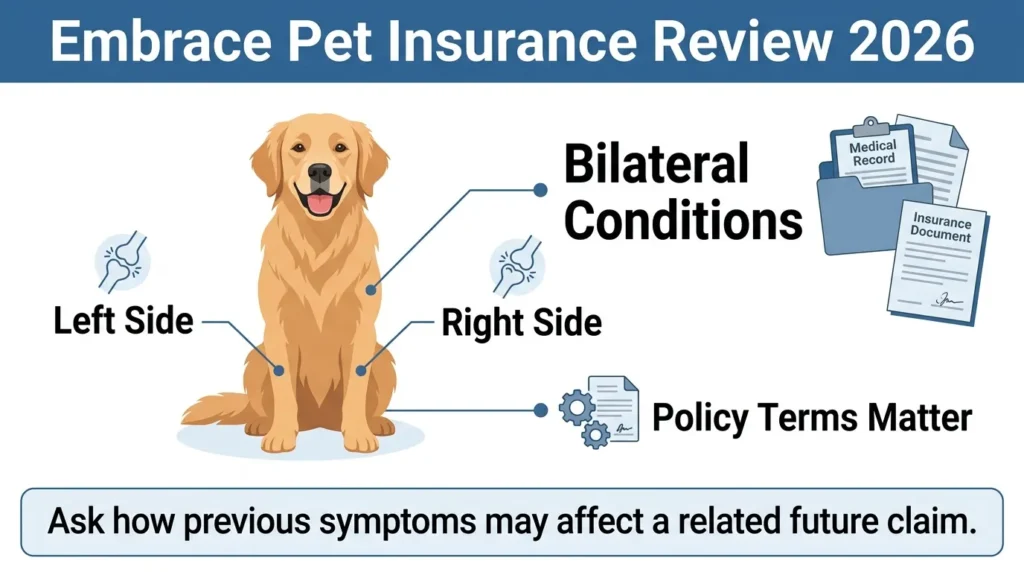
A bilateral condition affects paired body parts, such as the knees, hips, or eyes. If clinical signs of a related condition appeared on one side before coverage or during an applicable waiting period, a later occurrence on the other side may be treated as pre-existing under Embrace’s terms. The result depends on the diagnosis, timing, policy wording, and medical records. Ask Embrace how the provision would apply to your pet’s specific history.
Claim-processing time depends on the claim type, medical-record review, and whether Embrace has received all required documents. A first claim may take longer if additional medical history is requested. Check Embrace’s current claims guidance and policy documents for the latest processing information.
Embrace states that renewal pricing may be affected by factors such as your pet’s age, location, policy changes, and broader veterinary-cost trends. Premiums can change over time, but the amount varies by pet, state, policy, and renewal period. Review your renewal documents rather than assuming the first-year price will remain unchanged.
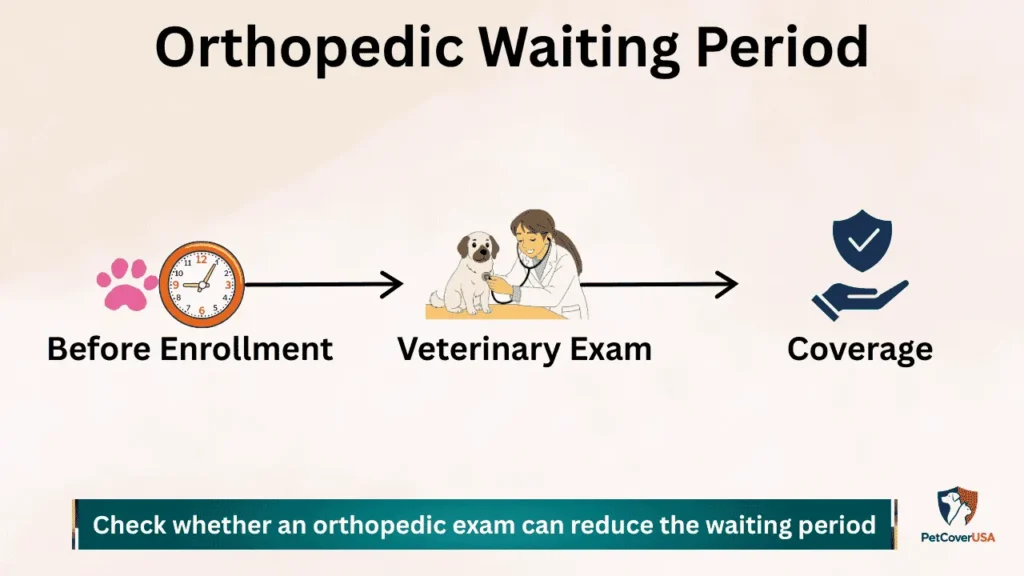
Whether an orthopedic waiting-period reduction is useful depends on your pet, state, policy, and medical history. Embrace’s terms may allow an orthopedic waiting period to be reduced after a qualifying examination, but the available reduction and exam deadline vary by state. Information recorded during the examination may be considered when assessing pre-existing conditions. Review the current state-specific terms and discuss the exam with your veterinarian before submitting it.
Embrace states that covered care may be received from any licensed veterinarian in the United States, including specialists, subject to the policy terms. Confirm geographic limitations, eligible services, and any travel-related conditions before relying on coverage outside the United States.
Embrace policies are underwritten by American Modern Insurance Group, which Embrace identifies as part of the Munich Re group. Underwriting and ownership are different from the claims and coverage terms that apply to your policy, so review the policy documents and current company disclosures before enrolling.
Bottom Line: Is Embrace Worth It?
It is wise to learn about Embrace Pet Insurance if obtaining accident and illness coverage is the aim but the names of the insurance company and costs involved should not be the main factor dictating your choice.
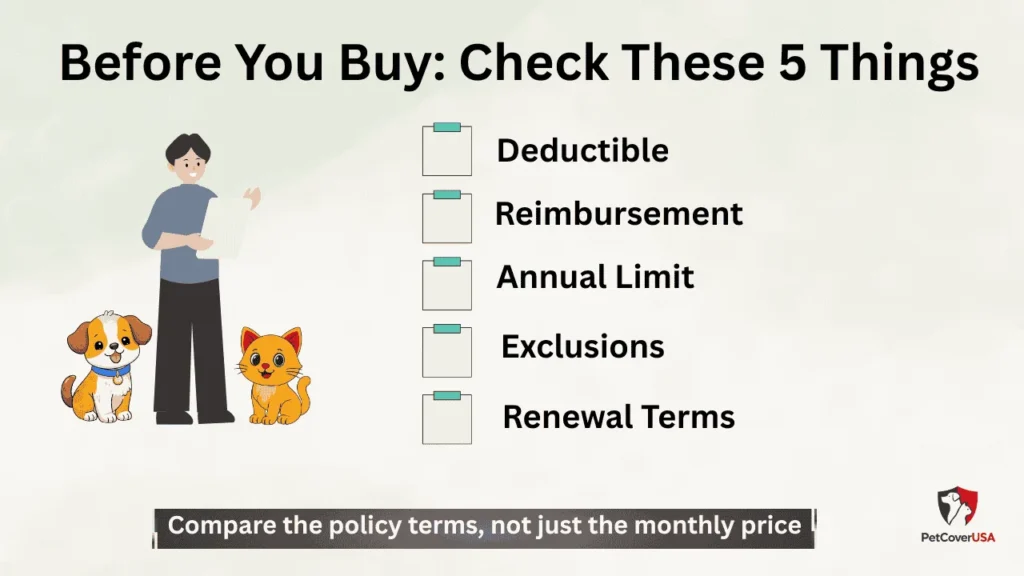
What matters most is making sure you are aware of how the insurance policy works in connection with your pet. Investigate the animal’s medical history, check waiting periods, find out about the deductible and reimbursement program, and understand how claims and appeals are done lt before the actual need arises.
If your pet suffered from health issues before take a note of the fact that Embrace offers medical history review after you enroll your pet. In case you have questions regarding any of the policy points, make sure you ask for guidance in writing and keep it together with your documents related to the insurance contract.
Going over various options may not eliminate all potential uncertainties but will take you closer to the right decision and help you avoid purchasing the insurance based on an assumption.
Before you proceed further, make sure you read the policy documents, state-related conditions and double check the important details of the plan with Embrace.
Trusted External Resources
Our content is supported by information from established organizations and public educational sources to ensure accuracy and transparency.
-
ASPCA – Pet Insurance & Veterinary Care Guide
Nonprofit animal welfare organization offering educational resources for pet owners. -
American Veterinary Medical Association (AVMA)
Official U.S. veterinary association providing professional guidance on pet healthcare. -
U.S. Food & Drug Administration – Animal & Veterinary
Government resource for veterinary medicine safety and regulations. -
North American Pet Health Insurance Association (NAPHIA)
Official industry body publishing annual pet insurance market data and statistics. -
Better Business Bureau – Embrace Pet Insurance Profile
Independent nonprofit organization tracking business complaints and customer reviews. -
Federal Trade Commission (FTC) – Endorsement & Review Guidelines
U.S. government guidelines ensuring transparency in online reviews and recommendations.
External references are included for informational purposes to support accuracy and research quality.
Related Pet Insurance Guides
If you’re comparing Embrace with other pet insurance providers, our Lemonade pet insurance review provides another provider-specific option to consider.
For a broader look at coverage, limits, and policy features, see our guide to pet insurance coverage and benefits .
If you’re mainly focused on keeping premiums manageable, our guide to affordable pet insurance plans for dogs and cats covers the main cost and coverage considerations.
Pet owners with older dogs may also want to review our guide to pet insurance for senior dogs over 10 years old before choosing a policy.
If you’re researching exclusions, our guide to pre-existing conditions and pet insurance explains an important coverage consideration.
📅 Last Updated:

About the Author
M. Nouman is an independent researcher and writer focused on U.S. pet insurance. He reviews insurer policy documents, coverage terms, waiting periods, reimbursement options, exclusions, and publicly available veterinary and regulatory resources to create clear, research-based guides. His goal is to simplify complex insurance information so pet owners can make informed decisions based on reliable sources rather than marketing claims. Articles are reviewed and updated as policies and industry information change.
Areas of Research: Pet Insurance Policies, Coverage Analysis, Policy Comparisons, Waiting Periods, Reimbursement Models, Policy Exclusions, Claims Education