
Natural Dog Shampoo for Sensitive Skin: What Actually Helps (and What Most Guides Leave Out)
While there might not be a universal “best” option when it comes to natural shampoos for dogs with sensitive skin, the important takeaway is that you’re looking for something mild, with an appropriate pH level based on the cause of your dog’s irritation. If the itching does not improve after a few baths, it may be a sign that shampoo alone is not solving the problem.
Who Is This Guide For
This guide applies to pet parents who have a scratching dog, a dog with flaky skin, or a dog that does not respond properly to commercial shampoos. It will help you, for example, if you’ve already tried natural shampoo but for some reason failed to get the desired results.
Who Should Skip This Guide
If your dog suffers from oozing wounds, bleeding areas of infection, or any signs of infection, it is wise to contact your veterinarian before using a shampoo product. Even if a shampoo is labeled natural, it is not a treatment for an active infection.
- What You’ll Learn
- Why “Natural” Doesn’t Automatically Mean Gentle
- Why Your Dog’s Skin Needs a Different pH Than Yours
- Ingredients With Real Support vs. Ingredients That Are Mostly Hype
- The Safety Issue Almost No Natural-Shampoo Blog Mentions
- When the Itch Isn’t Actually a Shampoo Problem
- Natural Shampoo vs. Medicated Shampoo
- A Realistic Scenario
- FAQs About Natural Dog Shampoo
- Final Thoughts
What You’ll Learn
- Learn why ‘natural’ is not a strictly regulated claim on pet shampoo labels
- Learn how your dog’s and your skin pH is different
- Know the few ingredients that have proof of efficacy
- Find out the only safety problem that has little coverage on natural shampoo blogs
- Understand when your dog’s itching is not related to the shampoo
Why “Natural” Doesn’t Automatically Mean Gentle
In my research, I found that the term ‘natural’ does not carry much legal meaning on pet shampoo labels.
In the United States, there are regulations set by the Food and Drug Administration (FDA) that classify any puppy shampoo that makes claims to have medicinal properties as a drug. Shampoos sold only for cleansing are generally treated as grooming products, which means they are not reviewed by the FDA before sale.
This means that terms such as “hypoallergenic,” “anti-itch,” and “natural” may be used without anything to support their claims about the effectiveness of a given shampoo. However, this does not mean that any shampoo labeled “natural” is lying.
Why Your Dog’s Skin Needs a Different pH Than Yours
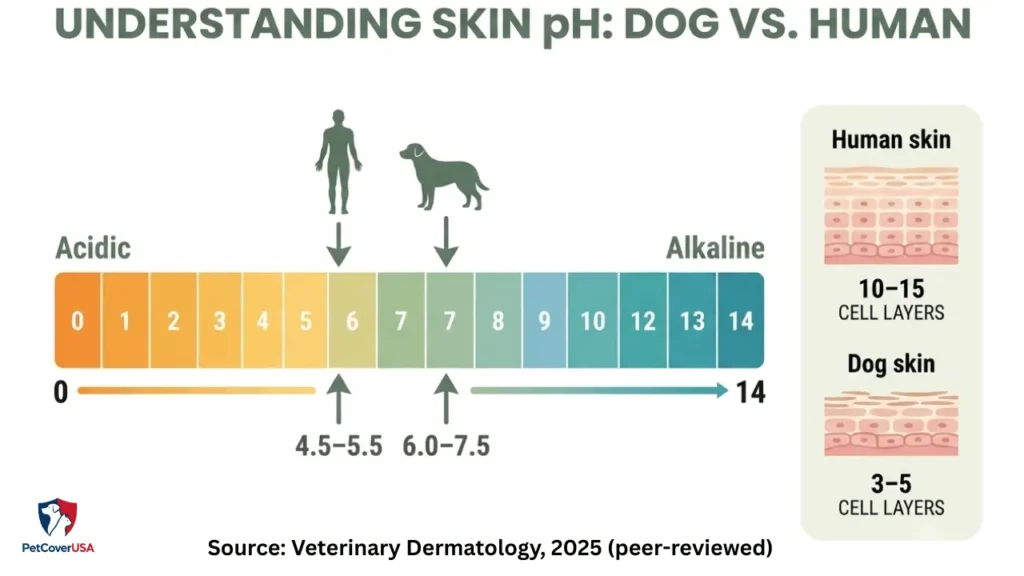
This is another detail many people do not realize. A 2025 study published in the peer-reviewed journal Veterinary Dermatology shows that dog skin pH is usually more alkaline than human skin and varies according to a dog’s age, sex, or breed. Human skin is generally more acidic than normal. Dog skin is neutral or slightly alkaline. Because of this difference, many veterinarians advise against using human shampoo on dogs, since their skin barrier is thinner and more sensitive.
Quick Comparison
| Humans | Dogs | |
|---|---|---|
| General skin pH tendency | More acidic | Closer to neutral or slightly alkaline |
| Outer skin layer | Thicker | Thinner, more permeable |
| Varies by | Individual, age | Individual, age, sex, breed |
Because this varies dog to dog, treat any single pH number you find online as a reference point, not a guarantee for your specific dog.
Ingredients With Real Support vs. Ingredients That Are Mostly Hype
| Ingredient | Commonly Used For | Worth Knowing |
|---|---|---|
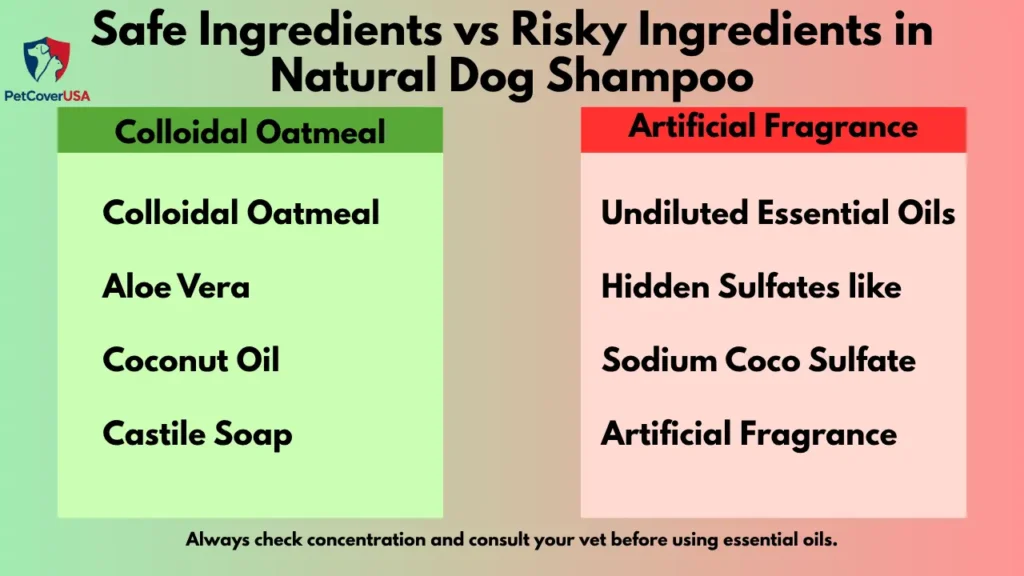
| Colloidal oatmeal | Soothing dry, itchy skin | Appears in both natural and medicated formulas |
| Aloe vera | Mild cooling and moisturizing | Generally well tolerated; check for added alcohol in some formulas |
| Coconut oil / castile soap | Gentle cleansing base | Can still be drying with frequent use |
| Essential oils (tea tree, citrus, lavender) | Marketed as natural pest control or soothing agents | See the safety section below — this one needs real caution |
The Safety Issue Almost No Natural-Shampoo Blog Mentions
A number of guides on how to make dog shampoo from natural ingredients talk about the addition of essential oils, especially tea tree oils, in homemade recipes. However, based on veterinary poison-control guidance, this is something to treat with extra caution.
According to the American College of Veterinary Pharmacists, the application of only 7-8 drops of concentrated tea tree oil on the skin can be fatal to dogs and cats. However, low-concentration products such as well-formulated detergents are mostly safe.
According to PetMD, tea tree oil concentrations of around 1-2% are typically non-toxic for dogs, but that can only be true if the product is used in compliance with all instructions.
If a DIY recipe prescribes the use of essential oils but doesn’t mention a safe concentration regarding the size of your dog, it is better to avoid it or purchase a pet-tested product.
When the Itch Isn’t Actually a Shampoo Problem
Many articles related to “best natural shampoo” miss this portion out, but this might be the most helpful section in the whole guide.
“Fritofeet.” When your dogs’ paws smell like corn chips, they usually are not dirty. According to PetMD, this smell usually comes from either yeast (Malassezia) or bacteria that typically live on the skin and may intensify in cases of active infection, which a replacement of the shampoo alone may not treat.
The myth of grain-free diets. Many “natural” and grain-free advertisements suggest that the problem is only due to the diet. However, as per the Veterinary Medicine Division of Michigan State University, many dog allergies are linked to specific proteins rather than grains, meaning that switching to a grain-free diet will not generally help unless the dog suffers from a grain-specific allergy (which is rare).
How common is this? According to the veterinary college of Cornell University, atopic dermatitis, which is a chronic allergic skin condition, may influence up to 10 to 15% of dogs. If your dog keeps itching no matter which shampoo you try, it is worth mentioning that to your vet instead of buying another bottle.
Natural Shampoo vs. Medicated Shampoo
| Natural / Cosmetic Shampoo | Medicated Shampoo | |
|---|---|---|
| Regulatory status | Grooming aid, not reviewed by the FDA | Regulated as a drug when treating a diagnosed condition |
| Generally best for | Everyday cleansing, mild dryness | Diagnosed infections or vet-prescribed skin conditions |
| Usually needs a vet? | Not necessarily | Often yes, for an accurate diagnosis first |
| Reliable against yeast/bacterial infection? | Not on its own | Formulated specifically for this |
A Realistic Scenario
Imagine your dog’s paws have that “corn chip” smell that is not going away after two or three washes, and you have even tried different shampoos. This can point to a yeast or bacterial issue, which means another shampoo may not solve it. Compared to the above-mentioned criteria, it is better to have this kind of detail reported to the veterinarian instead of wasting time trying other shampoos.
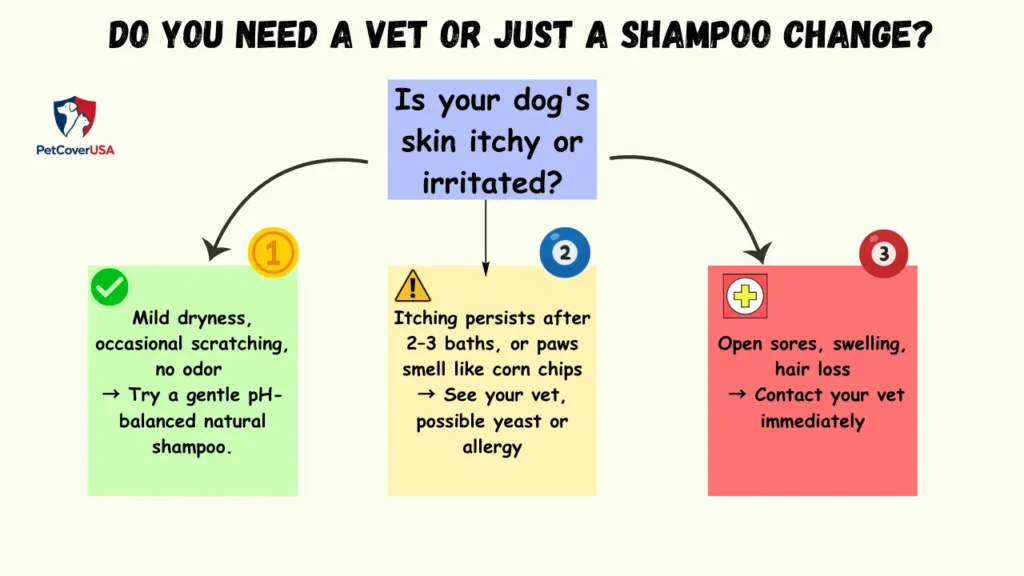
A helpful decision framework
- If your dog has mild dryness or occasional scratching and there is no odor or redness, a gentle pH-balanced shampoo may be a reasonable place to start.
- If your dog continues scratching or has a corn chip smell from his feet, it might mean there is an issue with yeast, bacteria, or allergies.
- If there is hair loss, swelling, or an open sore, do not bother getting shampoo and head straight to the vet.
FAQs About Natural Dog Shampoo
Is “hypoallergenic” dog shampoo actually regulated?
No, not the way medications are. Cosmetic-style pet shampoo claims aren’t reviewed by the FDA before reaching shelves, so “hypoallergenic” functions as a marketing term rather than a certified standard.
Can I safely add essential oils to a homemade dog shampoo?
It depends heavily on concentration and dosage, and getting this wrong can be genuinely dangerous. If you’re not confident about the exact safe concentration for your dog’s size, a pre-formulated, tested product is generally the lower-risk choice.
Why does my dog still smell after a bath with natural shampoo?
A lingering “corn chip” smell, especially around the paws, is often linked to yeast or bacteria on the skin rather than dirt, and a cosmetic shampoo alone may not resolve it.
Will switching to grain-free food fix my dog’s itchy skin?
Not necessarily. Most canine allergies are linked to specific proteins rather than grains, so a grain-free switch may not address the actual cause.
Is a “coconut-derived” ingredient automatically sulfate-free?
Not always. Some coconut-derived surfactants are still classified as sulfates, even though the name sounds gentler. Reading the full ingredient name, rather than the front-of-bottle claim, is the more reliable check.
Can I use my dog’s shampoo on my cat?
This isn’t something to assume is safe. Dogs and cats can react very differently to the same ingredients, and some dog-specific products aren’t appropriate for cats. When in doubt, use a product labeled for the specific animal, or check with your vet.
How do I know if my dog’s skin issue needs a vet instead of a new shampoo?
If the itching persists after a few baths, worsens, or comes with redness, swelling, or hair loss, that’s generally a signal to book a vet visit rather than try another product.
Final Thoughts
According to what I have analyzed in the guide, there is no shampoo that can help with every skin problem, and this does not reflect badly on any brand. It is simply the way skin conditions work. A gentle shampoo with the right pH can help with mild dryness and everyday skin sensitivity.
However, if your dog’s issues come back again, it would be better to consider them as a source of information rather than a reason to buy more shampoos. A simple visit to a vet may help you to rule out such possibilities as yeast, allergy to food, or environmental allergens and save you many unsuccessful attempts in getting the right shampoo.
Related Dog Care Guides
If your dog has sensitive skin, grooming is only one part of maintaining overall health. You can also explore our guide to taking care of a puppy at home for practical everyday care information.
Dental health is another important part of routine dog care. See our dog dental care tips for healthy teeth for practical oral-care guidance.
If you’re also researching pet insurance alongside your dog’s healthcare needs, our guide to comprehensive pet insurance coverage provides a broader overview of policy features to compare.
For dogs with ongoing health considerations, it’s also useful to understand how pet insurance handles pre-existing conditions .
If you’re specifically looking for dental-care information, you can also read our guide to dog dental cleaning at home and professionally .
📅 Last Updated:

About the Author
M. Nouman is an independent researcher and writer focused on U.S. pet insurance. He reviews insurer policy documents, coverage terms, waiting periods, reimbursement options, exclusions, and publicly available veterinary and regulatory resources to create clear, research-based guides. His goal is to simplify complex insurance information so pet owners can make informed decisions based on reliable sources rather than marketing claims. Articles are reviewed and updated as policies and industry information change.
Areas of Research: Pet Insurance Policies, Coverage Analysis, Policy Comparisons, Waiting Periods, Reimbursement Models, Policy Exclusions, Claims Education