
Cat Clicker Training: The Complete Science-Backed Guide That Actually Works
If your cat ignores the clicker, runs away at the sound, or only performs tricks when a treat is hanging in front of their nose, then you are not doing it wrong. You are just missing some points that every other guide skips.
I have spent months researching this topic because I was having the same problem with my own cat, going through peer-reviewed shelter studies, going in depth through hundreds of Reddit posts on r/Cattraining, and cross-referencing what actual cat behavior experts say and what get copy pasted across the internet. What I found during my research surprised me. Most clicker training guides give you the same five steps that are repeated again and again. They don’t tell you what happens when those steps fail, which they tell you, why those steps fail, and what to do about it.
This guide will cover everything. Every section covers something real— a friction point, a neurological reason, a technique that actually changes your cat’s behavior, and answers you that why is my cat scared of the clicker. No filler. No Padding. Let’s get into it.
What Is Cat Clicker Training, Really?
Clicker training is a method of positive support that uses a small device, “The Clicker,” to mark the exact moment your cat does what you want it to repeat again and again. You click the cliker and then treat the cat. With the passage of time, your cat connects the sound to a reward, and eventually connects specific behavior to both.
Simple in theory. Surprisingly technical in practice.
Here are things that most guides miss: the clicker is not magic. It works because of a specific neurological mechanism. When your cat hears a click that accurately predicts a reward, their dopamine starts responding to the click, not at the treat. This is called a reward prediction error, and it is the same mechanism that makes slot machines addictive. Your cat gets a neurochemical hit the moment that the click sounds, before the food even arrives. That is why timing matters so much. A late click may be neurologically confusing to your cat, not just unhelpful.
In my opinion, understanding this one concept makes you a better trainer of your cat immediately. You stop treating the click as a reward tool and start treating it as a precision communication device.
Do Cats Actually Learn From Clickers? (What the Research Says)
Yes, and the data is more specific than most blogs explain.
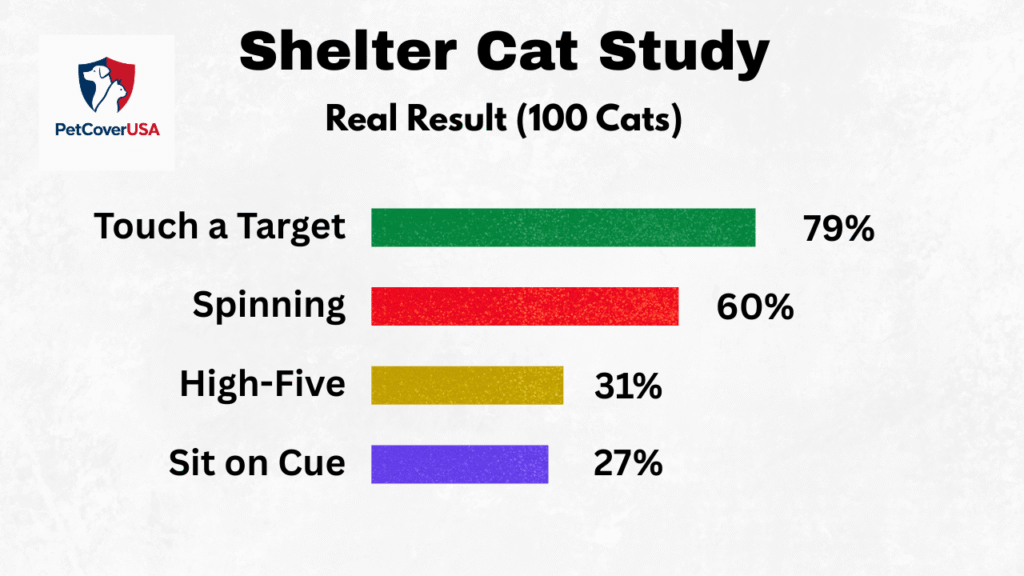
A peer-reviewed study involving 100 shelter cats ran 15 training sessions of five minutes each over two weeks. Here’s what they found:
- 79% of cats mastered touching a target
- 60% mastered spinning on cue
- 31% mastered a high-five
- 27% mastered sitting on cue
The most important finding? The cat’s age had no effect on success. The researchers found that age and sex were not significant predictors of learning results. What really predicted success was how motivated the cats were by food and personality. Bold cats performed better than shy cats.
So, if someone tells you that your senior cat is too old for clicker training, that’s not what the science says. The real thing is whether your cat is hungry enough and calm enough to engage in the clicker training.
Dr. Sarah Ellis, a feline behavior specialist and co-author of The Trainable Cat, puts it plainly:
“Cats are not untrainable. They’re differently motivated than dogs. Understand the motivation and you understand the cat.”
Dr. Sarah Ellis
This difference in motivation is the key idea for everything that comes next.
The Part That Actually Stops People: The Clicker Sound Problem
Here’s something I found repeatedly in my Reddit research that almost no blogs cover.
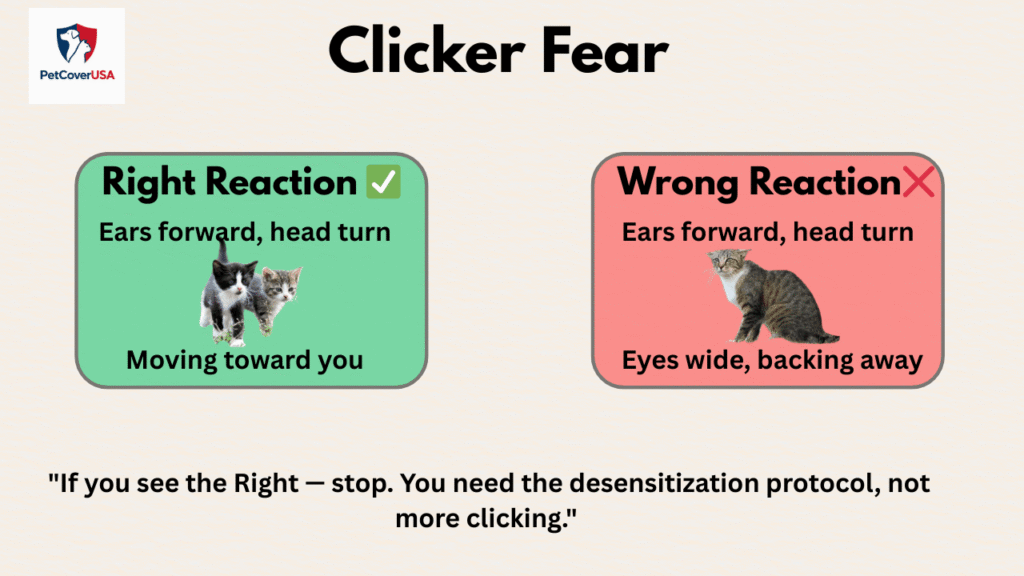
A significant portion of cat owners report that their cat is “afraid of the clicker”. Not just a little surprised. Really scared, with ears back, running away, and not wanting to come back into the room. And what does the standard advice say? “Just keep doing it, your cat will get used to it.”
That advice can actually make things worse. If you try to train while the animal is scared, it may start linking fear with you, the treat, and the training situation.
Here is what actually works, based on my research into behavioral desensitization protocols:
Step 1:
Start with the clicker in your pocket. Fully muffled. Click one time and toss a treat in your cat’s direction. Do this 15-20 times across two or three sessions. You are not training a behavior now; you are just making a muffled sound to predict good things.
Step 2:
Move to holding it in your cupped hand so it’s less muffled, and repeat the same steps. Watch your cat’s body language. You want to see it turn its head toward you in expectation, not pull away in fear.
Step 3:
Slowly make the sound less muffled over different sessions, not in the same session. Only move forward when the cat does not show any reaction or fear.
Step 4:
If the clicker still causes fear at any point, completely switch tools. A soft tongue-click(“tsk”), a single syllable verbal marker (“yes”), or even a pen-click works on the same principle. The consistency matters, not the specific sound.
I want to be clear here: There is no rule that says you must have to use a plastic clicker. The procedure, a consistent marker paired with food, is what matters the most. Your marker can be anything as long as it’s always the same, always fast, and always followed by a treat.
How to Actually Start: Step-by-Step Without the Oversimplification
Most guides tell you to “charge the clicker first.” That Ok, but here are things that they skip:
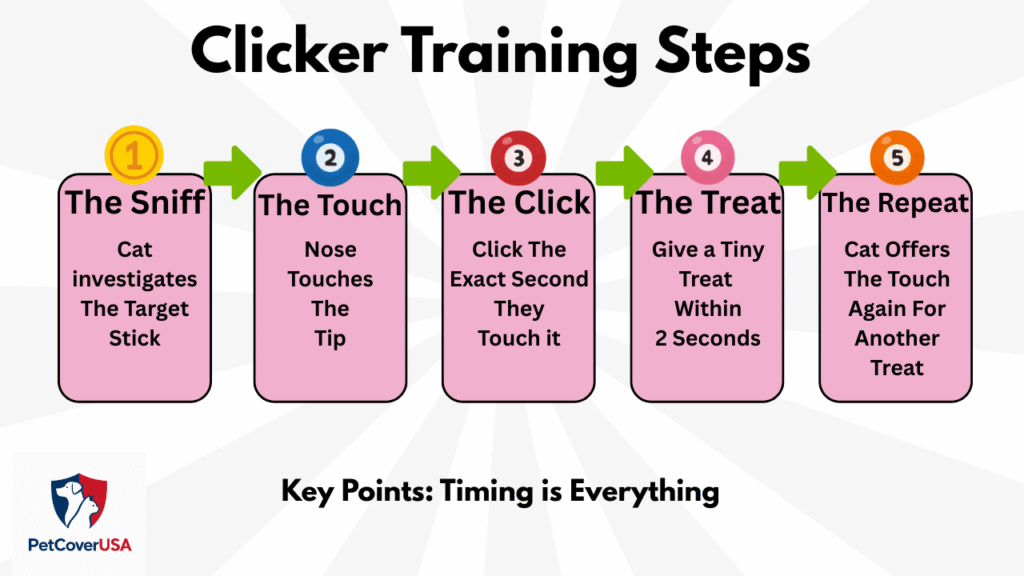
To train the clicker, pair it with food so the sound alone makes the cat expect a treat. Click, then give a treat. Repeat this 15–30 times over a few short sessions. You’ll know it’s working when your cat turns its head toward you after hearing the click, before seeing the treat.
Choosing the first behavior is where many people make mistakes. They try to teach “sit” because that’s common for dogs. But research shows that teaching a cat to touch its nose to a stick or your finger is much easier and has a very high success rate. You should start with that.
Luring can be a real problem. If you move a treat to guide your cat, it may work at first. But the cat learns to follow the treat, not to respond to your signal. Many people notice that their cat only behaves when the treat is visible and ignores the cue without it. The solution is to stop using the treat as a guide early on, switch to using an empty hand signal, and then give the food from a different place.
The verbal command should be added at the end. Many people add it too early, which is the wrong order. First, the behavior should happen consistently. Then you attach a word to it. Say the word just before the behavior happens. After many repetitions, the word becomes the signal. If you say the word while the cat is still learning what to do, it will just ignore it.
The Multi-Cat Problem Nobody Talks About
If you have more than one cat, standard clicker advice may immediately fall apart in a specific way because one click is heard by every cat in the room.
This can create a real problem. Your other cat might learn that the first cat’s action means a treat is coming and start doing it without being asked. More often, both cats run to you when they hear the click, even if only one earned it. This can cause competition, stress, and make the training ineffective.
In my opinion, after researching how professional trainers handle this:
You should use two different markers. You should use a clicker for Cat A, a verbal “yes” for Cat B. Each marker is charged separately to its respective Cat. This thing requires different charging sessions first, but once it is done, you can theoretically train both cats in the same room with one marker, never confusing the other.
Station training works better for most people than trying to separate signals between cats. Each cat has its own spot, like a mat or chair, and learns to stay there while the other cat is being trained. You reward the cat for staying in its place. This turns the problem into another chance to train.
The easiest method is to train one cat, then move it to another room and train the second cat. It’s straightforward. But many guides don’t explain why this works, so people ignore it and then wonder why their training turns into begging for treats.
When Your Cat Knows the Trick But Won’t Do It
This is the plateau problem. You teach a behavior, like sit or high-five, and your cat clearly understands it. Then suddenly, it stops doing it, or only does it in certain places, at certain times, or when it sees the treat pouch
From my research into this specific pattern, there are five distinct causes:
Context specificity
Cats don’t automatically apply a learned behavior to new places like dogs often do. If you teach your cat to “sit” in the kitchen, your cat may think it only applies there. To use it in another room, you need to practice it again in that space, but it usually becomes easier the second time.
Treat satiation
If you train your cat right after a meal, your cat’s food motivation will be at its lowest. The same treat that was thrilling before breakfast is uninteresting after dinner.
Criteria confusion.
You may have unknowingly made it harder by expecting quicker responses, better accuracy, or longer holding time, without rewarding the small steps needed to get there.
Lure dependency
As I mentioned above. If a treat was visible in your hand during training, the treat is part of the cue. If you remove it, and the cue is incomplete
Reinforcement history erosion
If you keep using the same reward pattern for weeks, the behavior can start to fade. After the cat learns the behavior, you should slowly change how often you give treats. First reward every time, then less often, and later at random times. Random rewards help keep the behavior strong better than always rewarding it.
Using Clicker Training to Solve Real Problems (Not Just Teach Tricks)
Counter surfing:
If you click when your cat jumps off the counter, you reward the “getting off” action. But the cat may also learn that jumping on the counter starts a training game. A better way is to teach a “go to your place” command so the cat goes to a specific spot before getting on the counter. You should also remove food or anything that attracts the cat.
Carrier training:
You should guide your cat into the carrier using a stick or your finger. Reward small steps: one paw inside, then two, then fully inside. Later reward when the door closes briefly. Increase the time slowly over different sessions. Many cats that used to be forced into carriers start walking in on their own after a few weeks with this method.
Vet visit preparation:
Studies with zoo animals show that animals trained to cooperate with handling feel less stress than those forced to stay still. You can do the same at home. You should train your cat to accept ear touches, paw handling, and mouth opening with short sessions and treats. This thing makes vet visits easier.
Inter-cat tension:
When Cat A stays calm around Cat B, reward that calm behavior, like looking away, lying down, or slow blinking. You are reinforcing a calm emotional state in a situation that used to cause tension. This method works but needs patience and enough distance between the cats so they can stay relaxed.
Deep Research Comparison: What My Blog Covers vs. The Top Competitors
| Topic | Competitor A | Competitor B | This Guide |
|---|---|---|---|
| Neurological mechanism of the click | Not covered | Not covered | Full dopamine + timing explanation |
| Clicker fear desensitization protocol | 1 sentence | Not covered | 4-step protocol with body language cues |
| Multi-cat training mechanics | “Train separately” | Not covered | Dual markers + station training method |
| Lure dependency fix | Not covered | Not covered | Fading protocol with timing guidance |
| Context generalization failure | Not covered | Not covered | 5-cause diagnosis + location retraining |
| Research data (shelter study) | Success rates only | Not covered | Full data including predictor variables |
| Treat fading schedule | “Reduce gradually” | Not covered | Variable ratio reinforcement explanation |
| Behavior problems (counter, carrier, vet) | Tricks only | Tricks only | 4 real-world applications with protocols |
| Fearful rescue cat adapted protocol | Not covered | Not covered | Pre-training trust phase explained |
| Free-fed cat motivation fix | Not covered | Not covered | Full data, including predictor variables |
The Free-Fed Cat Problem (And the Fix Most Guides Won’t Give You)
Food motivation is the biggest factor in successful clicker training for cats. If a cat always has food available, it often loses the motivation to work for treats.
Many trainers and vets agree that constant free-feeding can make training harder. A practical solution is to switch to two set mealtimes, morning and evening. Do training about 30 minutes before the evening meal, when your cat is naturally hungrier. The meal that follows also acts as an extra reward.
If changing the feeding schedule isn’t possible, use very high-value treats. Good options are small pieces of plain cooked chicken, Churu tubes, or tiny bits of cooked fish. Regular dry treats usually aren’t exciting enough for cats that already have constant food access.
FAQ’s About Cat Clicker Training
Can I use clicker training to stop bad behavior?
Clicker training is a positive reinforcement tool — you can’t click for the absence of something. Instead, train an incompatible behavior (being on their mat instead of on the counter) and manage the environment to reduce opportunities for the unwanted behavior.How long until my cat learns a behavior?
Based on the shelter study, most cats show measurable improvement within 15 five-minute sessions over two weeks. Simple behaviors like targeting often click within 3–5 sessions. Complex shaped behaviors like opening a cabinet can take months.My cat walked away mid-session. Did I do something wrong?
Probably your session ran too long, your treats dropped in value, or your criteria jumped too fast. Cats self-regulate. End the session, note what happened, and next time stop one repetition before you think you need to.Do I have to use a clicker forever?
No. Once a behavior is reliable, shift to a variable ratio schedule (reward unpredictably), then fade the treats while maintaining the behavior with occasional rewards. The clicker itself can be phased out once the behavior is on a verbal cue.What if my cat doesn’t care about any treats?
Rule out health issues first — sudden food disinterest can signal illness. If they’re healthy, try training right before meals, upgrading to fresh protein treats, or experimenting with play as a reinforcer for cats who are toy-motivated rather than food-motivated.A Note on Fearful and Rescue Cats
Research shows that anxiety makes learning harder for cats. Cats with higher stress levels learn more slowly, not because they are less intelligent, but because stress makes it harder for their brain to form new connections.
If you adopt a fearful or poorly socialized cat, you should not start training immediately. First, spend two to four weeks building trust. Let the cat approach you, offer food from your hand without asking for anything, and allow it to explore the clicker without using it. The cat needs to feel safe before real training can begin.
This is not just about being patient. Stress increases cortisol in the body, which can interfere with the brain’s ability to learn. Creating a calm and safe environment helps the cat’s brain become ready to learn.
Conclusion: What Makes This Work Long-Term
Clicker training works because it gives your cat real information at the exact right moment. The click says that what you just did is what earns the reward. No confusion, no guessing, no learning through frustration or correction.
But after all the research I have done, I come to the conclusion that technique is almost secondary. Understanding your specific cat’s food motivation, their anxiety baseline, their context sensitivity, and their arousal level around treats makes it work for a long time. The clicker is a precision tool, and like any precision tool, it only performs as well as the person using it understands what they are doing.
Now you understand more about it that why and how this works than most guides will ever teach you. The next step is to start with charging the clicker, pick targeting as your first behavior, keeping sessions under three minutes, and training before the meals. Everything else builds from there.
Your cat is more capable than most people give them credit for. The research confirms this. Now you need to go and prove it.
Sources
- PMC Shelter Study — Arhant et al., 2017
- ScienceDirect Bridging Stimulus Pilot Study — Willson et al., 2017
- Oxford Brookes Cat Training & Welfare Study, 2018
- Dorey & Cox Reinforcement Review, 2016
- Dr. Sarah Ellis — The Trainable Cat
Trusted External Resources
📅 Last Updated:
✅ Verified by: John Smith, Pet Insurance Specialist

About the Author
M. Nouman is a pet insurance researcher with over seven years of experience analyzing U.S. pet insurance policies, coverage terms, exclusions, and real claim practices. His work focuses on simplifying complex insurance language into clear, practical guidance so pet owners can make informed decisions based on research rather than promotional claims.
Expertise: Pet Insurance Reviews, Coverage Analysis, Claims Process, Policy Comparison
Research insights available on Quora and professional profile on LinkedIn .