
Some links on this page may be affiliate links.
Pet Insurance Claim Denied for Pre-Existing Condition? What to Check and How to Appeal
It can be perplexing to get your claim from your pet insurance rejected, especially when you were unaware of some previous test results, symptoms, or medical records from your pet. While you may think that the issue arose after the policy was made valid, the insurance company might see it as a pre-existing condition based on a previous veterinary treatment.
The exclusion of pre-existing conditions depends on the definitions mentioned in the policy, the waiting periods, and the medical records checked during the claim review. The earlier test results will not always help to conclude whether the later development should be excluded from coverage. One should remember that the reasoning of the insurance company and the wording of the contract matter.
If your claim was denied because of a pre-existing condition, it does not mean that the claim is correct and that the rejection cannot be overturned. The first step for you is to check the reason behind the rejection and the evidence behind it.
This article will explain how insurance companies use the already existing medical records and what you need to do if your claim is denied due to the results of the previous tests.
Why Was My Pet Insurance Claim Denied for Pre-Existing Condition?
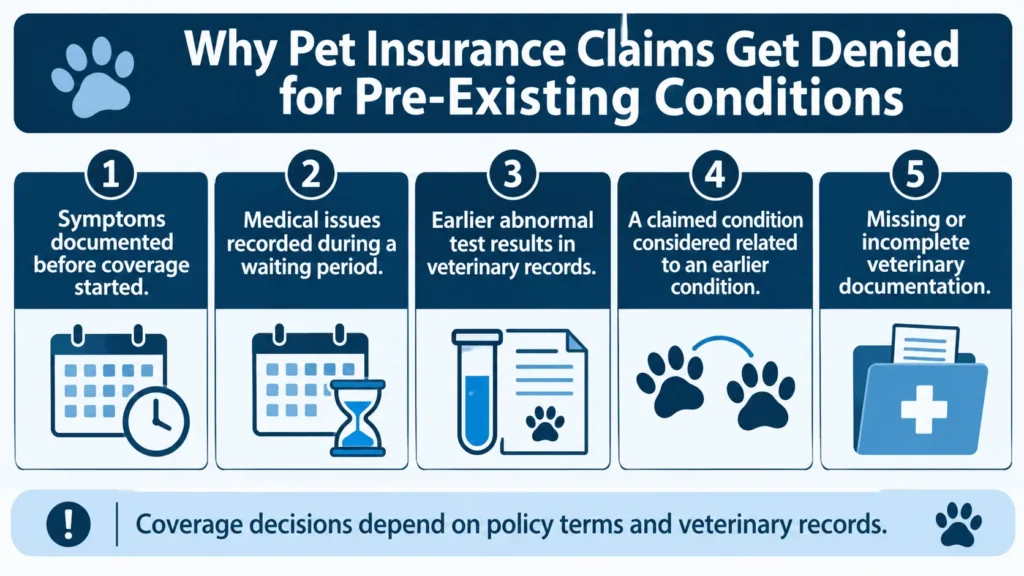
While many pet insurance providers exclude pre-existing conditions, the term may mean different things. Built into pet insurance policies are exclusions, restrictions, and waiting periods that differ according to the National Association of Insurance Commissioners (NAIC).
This means that depending on the best pet insurance policies, even symptoms, treatments, diagnoses, or notes made in the medical record prior to the time that the coverage takes effect will determine whether it is covered or not.
Below, we present some situations that might lead to a denial of coverage due to pre-existing conditions.
Source: NAIC Pet Insurance Guidance
Symptoms recorded before coverage began
Health troubles might already be seen in a pet before an owner buys health cover, with no visible signs at the time of actual diagnosis or treatment.
For instance, dog records may say there has been repeated limping prior to entering into the policy, with treatment done months later.
An insurance company can refer to older documents and case notes to understand whether the symptoms occurred earlier or not. Whether there is an exclusion depends on the wording of the policy and the evidence used.
Findings recorded during a waiting period
Getting a policy does not necessarily imply that all conditions are covered right away.
The waiting period is defined as the time period between the start of a policy and when coverage actually begins. If a condition is diagnosed or even begins treatment during the waiting period, this suggests that the condition would be classified as pre-existing under the terms of the policy.
For instance, Lemonade says that it has a 14-day waiting period for illness cases and a 30-day waiting period for orthopedic problems. These waiting periods are those stipulated by Lemonade and are not the same across all pet insurance companies.
Source: Lemonade’s pet insurance waiting-period guide.
Earlier test results cited in a later claim
When the insurer assesses a claim, they might look over prior bloodwork, urinalysis results, exam records, and other veterinary documents.
However, an unusual finding or suspected diagnosis does not equate with obtaining a diagnosis.
For instance, a previous lab report may indicate a number that is greater than the reference range or lower than the reference range value. Yet the result still has to be read in light of the pet’s clinical signs, examinations, confirmatory tests, and veterinary diagnosis.
What is critical is not the fact that the number was present in the first place but how the insurer connects the previous number to the current complaint made in the claim.
A previous condition may not be the same as a new condition
Sometimes, an insurer may consider a new claim related to an earlier illness or injury.
Ask the insurer to explain the medical and contractual basis for that connection. Do not assume that two conditions are related simply because they involve the same body area or have similar symptoms.
What to check first: Read the denial letter and identify the exact condition, medical record, date, and policy exclusion the insurer has cited. This gives you a starting point for reviewing the decision.
Can an Insurer Deny a Claim Because of Old or Abnormal Bloodwork?
Yes, prior blood tests might be taken into account when an insurance company examines a claim. Whether this piece of evidence qualifies for exclusion according to the policy depends on many factors, including the medical conditions and the terms of the insurance agreement.
A laboratory result cannot always provide a diagnosis by itself. Its meaning may depend on the test performed, its magnitude, the clinical condition of the animal, and the interpretation of the doctor.
Example: A Lemonade policyholder disputed a kidney-disease denial
A case in point is the case of a Lemonade policyholder who was rejected for a claim concerning a cat which was diagnosed with chronic kidney disease. According to the pet owner, Lemonade insurance referred to an earlier blood test showing changes in kidney readings.
The owner was not satisfied with the interpretation made by the insurer and stated that his vet did not classify this earlier blood test as an indication of a disease at that moment.
This is a particular incident of a dispute over insurance claims and does not establish whether the insurer’s decision was correct or not from a medical or legal point of view.
Source: Lemonade pet insurance claim denial discussion on Reddit.
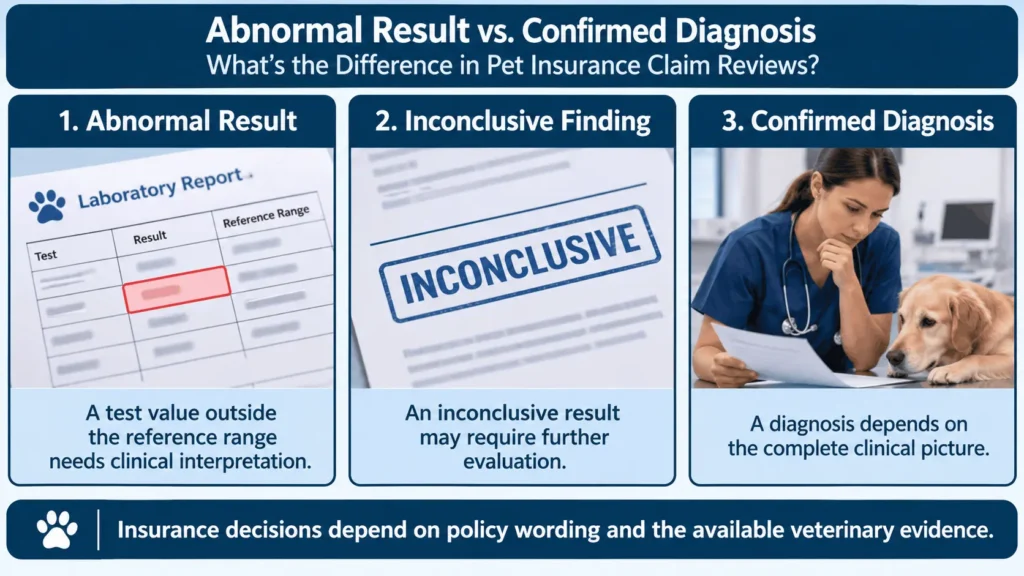
What can you do if an insurer relies on earlier bloodwork?
The first step is to demand the exact laboratory results that supported the denial of your claim. Do not accept anything vague that states something like the previous blood tests indicated that there was a pre-existing condition.
You may ask the insurance company the following questions about the specific test results:
- What tests did the denial rely upon?
- On what dates were those tests performed?
- Which section in the policy applies to this case?
- Does the denial concern an abnormal value, a symptom that has been recorded, a suspected disease, or an actual diagnosis?
- How does the previous result relate to the condition mentioned in your claim now?
A veterinarian might be able to provide you with an explanation that could clarify some points in the medical file. But remember that even with the clarification provided by the veterinarian, the insurance company is still not obligated to change the previous decision.
What If the Earlier Test Was Inconclusive?
An inconclusive test does not necessarily establish that a pet had a particular disease. It means the result did not provide a clear answer, although the exact meaning depends on the test and the circumstances.
This distinction can matter when an insurer uses an earlier test as evidence of a pre-existing condition.
Example: A MetLife policyholder challenged a denial involving an inconclusive urine sample
In a different thread on Reddit, a MetLife customer recounted that the puppy’s initial urine test returned an inconclusive result because it could have been contaminated while performing it at home.
According to this individual, another test conducted a month later produced a normal result. The poster states that MetLife first rejected another claim based on the prior result and the appropriate waiting period.
The individual appealed the decision by providing a letter from the veterinarian, but the text states that the appeal did not produce any results. The owner requested another appeal to secure a victory in the end and that an unbiased veterinarian had ruled in their favor in another update to the discussion.
This is a report of the findings of a policyholder, but this does not mean that every policyholder will face the same result with other insurance companies.
Source: MetLife inconclusive urine-test claim appeal discussion.
What should you do if an insurer relies on an inconclusive test?
Acquire the initial report and the subsequent report.
Clarify the following:
- What was the actual finding of the original report?
- What does the laboratory say regarding the results? Was it negative, normal, or inconclusive?
- Was another examination advised?
- What did the later report reveal?
- Was a diagnosis made by the laboratory, or were additional tests recommended only?
Consult with your vet to interpret the report, and see whether any further tests would be helpful.
A normal result from the follow-up examination is not necessarily strong evidence against the original report; certain medical conditions can be identified only by repeated testing or clinical evaluation over time.
What If You Were Never Told About the Earlier Medical Finding?
At times, pet owners learn about a previous medical record or lab report only after their insurance company takes a look at the pet’s files.
For instance, a claim rejection may point to the previous blood test results, examination records, or other conditions the owner does not recall alerting the veterinarian about.
You can check the insurer’s claim denying your request only after you have acquired the underlying medical information.
How to request your pet’s veterinary records
Make contact with the veterinary office where your pet was seen and ask for the available records.
There may be some variations between various clinics, but you should typically expect the following:
- Examination records and summaries.
- Test results.
- Urinalysis reports.
- Conditions diagnosed or thought to be likely.
- Medications and treatment history.
- Emergency clinic records.
- Policies for follow-up care.
According to Lemonade, information regarding pet medical records may include visits, test results, or any other data that is needed to understand your pet’s health records.
Source: Lemonade’s pet medical records guide.
What should you look for in the records?
Be very careful of the dates and the wording used by the vet.
For instance, the following terms will not always mean the same thing:
- “Suspected infection”
- “Abnormal laboratory result”
- “Further investigation advised”
- “Diagnosis confirmed.”
Keep in mind that these terms are not interchangeable and carry different medical meanings depending on the context and interpretation of the vet.
If any entry raises doubts, it is better to ask someone from the clinic for clarification. If the entry contains a factual error, ask the clinic if it is possible to correct the error or provide some additional information under their document archiving protocol.
What If the New Claim Is for a Different Condition?
A similar condition to a pre-existing condition does not mean that all future claims will not be honored.
The key point is whether this condition is covered under the terms of the insurance policy.
To illustrate, suppose a pooch was treated for an ear infection prior to the coverage being effective. After some time passes, the puppy has an ear infection again.
The insurance company may determine whether or not this condition resulted from the previous condition. Based on the insurance policy, the insurance company may deal differently with a new case as opposed to a recurrence of an earlier condition.
Different insurance companies also differentiate between chronic and non-chronic pre-existing conditions. For example, MetLife provides a description of the situations when a certain chronic pre-existing condition will be covered provided that certain treatment-free periods were honored. As in any case, it is important to know the rules of the particular insurance company and state.
Source: MetLife’s pre-existing-condition guidance.
What should you ask if two conditions are considered related?
Ask the insurer to explain:
- Which earlier condition is being used as the basis for the exclusion?
- What medical evidence connects it to the new claim?
- Which policy provision allows the exclusion?
- Does the policy distinguish between curable and chronic conditions?
- Is there a symptom-free or treatment-free period that applies?
You can also ask your veterinarian to explain the medical differences between the earlier and current conditions, if there are any.
Avoid deciding on your own that two conditions are unrelated. The medical evidence and the policy wording both need to be considered.
How to Appeal a Pet Insurance Claim Denial
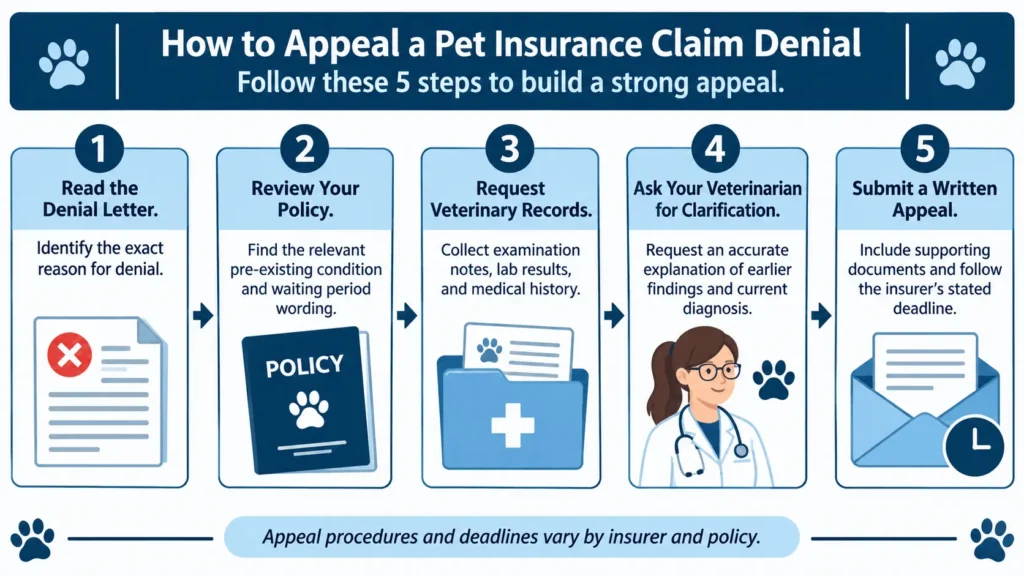
In case you suspect that the insurer has misread your medical history or made an error with respect to a particular clause in the insurance policy, request information about the procedure for filing an appeal or reviewing a decision.
The process across different insurers is not uniform. Timelines, documents required, and procedures for review may vary too much from one insurer to another, as well as from one region to another and one version of policy to another.
Step 1: Read the denial letter carefully
Identify the exact reason for the denial.
Look for:
- The condition or treatment that was excluded.
- The medical records cited.
- The dates of the relevant findings.
- The policy provision used.
- Instructions for submitting an appeal.
- The applicable deadline.
If the letter does not explain the decision clearly, contact the insurer and request a more specific explanation.
Step 2: Obtain the policy wording
It is not sufficient to just check general coverage information on the insurance company’s website.
You have to find your own coverage policy documents. You must check definitions, exclusions, waiting periods, and other aspects relating to pre-existing conditions.
Specific wording of your own policy is of greater importance than a general statement about how an insurance company works with claims.
Step 3: Collect the medical records cited in the denial
Request the original records and reports that the insurer used.
If the insurer relies on an earlier laboratory result, obtain that report rather than relying on a summary of the result.
Compare the dates with:
- The policy effective date.
- The end of the applicable waiting period.
- The date symptoms were first recorded.
- The date of diagnosis.
- The date of treatment.
This timeline can help you identify which facts need clarification.
Step 4: Ask your veterinarian for a factual explanation
In case of any ambiguities regarding the medical record or if the insurance company hasn’t understood something, get in touch with your veterinarian for clarification.
A helpful letter from the veterinarian should talk about:
- The result of past examination.
- The conclusive or inconclusive nature of the result.
- If a diagnosis was made.
- If any other tests were suggested.
- What the subsequent examination established.
The veterinarian should give you an accurate and independent medical explanation and refrain from making unsupported comments.
Step 5: Prepare your appeal with supporting evidence
Simply arrange the records logically. Give a brief rationale as to why the resolution should be assessed.
Steer clear of an extensive emotional grievance that fails to reference the actual part of the resolution subject to challenge.
For example, if the insurer based its conclusion on an inconclusive urine sample, point out which report was inconclusive, share the new result, and add the veterinarian’s explanation if there is one.
Step 6: Submit the appeal before the deadline
Comply with what the insurer says about submitting a claim.
Retain copies of the claim letter as well as the documents supporting it, confirmation that your claim has been accepted, and any reaction to your submission from the insurer.
If in doubt, check with the insurer for confirmation of any deadlines.
Example: Embrace’s published appeal process
Embrace communicates that there is a procedure for policyholders to appeal any decisions made regarding claims or medical history reviews. In its official guidelines, the company advises attaching a letter from a veterinarian that explains why the assessment could be inaccurate, along with other supporting documents such as relevant medical history and lab results.
According to current Embrace’s guidelines, appeals must be filed within 60 days after the renewal of the insurance plan. Furthermore, it states that the second appeal can be filed within 30 days after the first appeal decision.
These are Embrace’s company procedures. They should not be seen as deadlines or rules of any other insurance company. It is recommended to verify the instructions and version of the policy for the insurance coverage you receive.
Source: Embrace’s official claim appeal guidance.
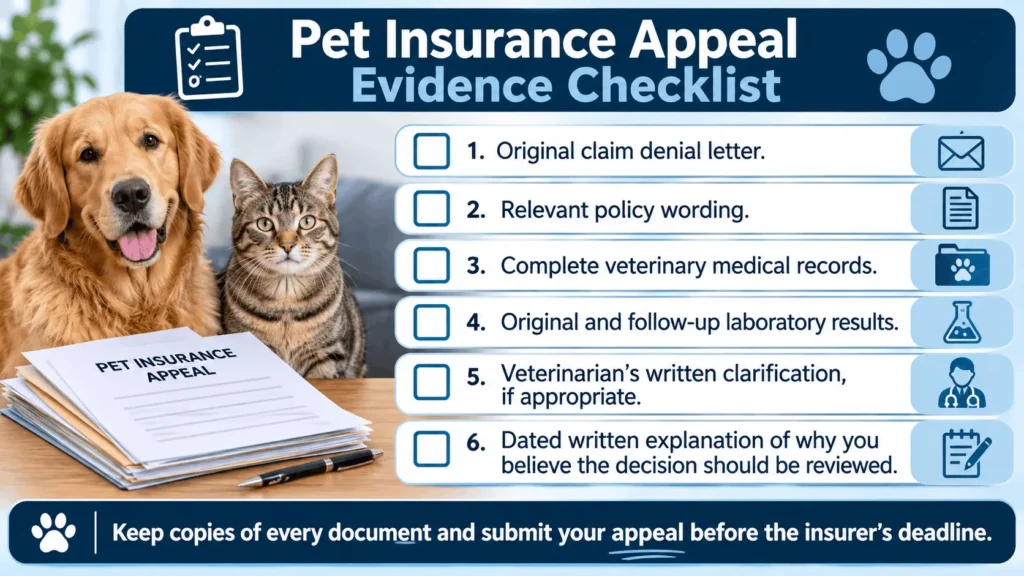
What Documents Should You Collect Before Appealing?
Use this checklist to organize your evidence before submitting an appeal.
Claim and policy documents
- Claim denial letter.
- Complete policy wording.
- Policy effective date.
- Applicable waiting-period details.
- Claim number and insurer correspondence.
Veterinary records
- Earlier examination notes.
- Original bloodwork or urine-test reports.
- Follow-up laboratory results.
- Diagnosis and treatment history.
- Relevant emergency or specialist records.
Supporting explanation
- Veterinarian’s factual clarification, if appropriate.
- A timeline of relevant medical events.
- A written explanation identifying the part of the denial you dispute.
Not every appeal requires every document. Focus on the specific evidence relevant to the insurer’s stated reason for denial.
What If the Insurer Denies Your Appeal?
An unsuccessful appeal doesn’t mean you have no further options left. What your next step will entail largely depends on the insurer’s complaint procedure, policy, and the rules in your state.
To begin, ask that the insurer give you its final decision in writing. In the request, you should ask it to detail the policy provisions and evidence on which it is relying.
Then look into the insurer’s complaint process and see which party your state’s insurance department will accept complaints from.
The NAIC provides consumer insurance information and links to state insurance departments. Source: NAIC consumer information.
Remember, before you file a complaint, it doesn’t guarantee that the insurer will reimburse you or change its decision. Depending on your state, the role a regulator plays will vary.
Lastly, if the amount of money involved in the dispute is big or the policy is complicated, you could seek legal advice from a qualified legal practitioner who can give you the latest advice on the matter.
Frequently Asked Questions
Yes, depending on the policy. Some insurers consider symptoms recorded before coverage began or during a waiting period, even if the pet received a formal diagnosis later.
Check the policy definition of a pre-existing condition and the medical records cited in the denial.
You can ask your insurer about its appeal or review procedure. Many insurers publish instructions for disputing claim decisions, but deadlines and requirements differ.
Read the denial letter and your policy documents before submitting an appeal.
Obtain the original test report and any follow-up results. Ask your veterinarian to explain what the findings established and whether further testing was needed.
An inconclusive result does not automatically establish a diagnosis, but a later normal result does not automatically settle the insurance dispute either.
Request the original veterinary records and ask the practice to clarify any unclear findings.
Check the dates and wording before deciding whether the insurer has interpreted the record correctly.
An insurer may investigate whether a new condition is related to an earlier medical problem. Whether an exclusion applies depends on the policy wording and supporting medical evidence.
Ask the insurer to explain the connection it is relying on and request the specific records and policy provisions behind the decision.
No. An abnormal laboratory value is not necessarily the same as a confirmed diagnosis. Its significance depends on the test, the pet’s medical history, and the veterinarian’s interpretation.
However, an insurer may consider an earlier abnormal result when reviewing a claim, depending on the policy terms and evidence.
Conclusion: Review the Evidence Before Giving Up
You should first start by finding the reason for denial of your pet insurance claim due to the pre-existing condition. Based on that, review your insurance policy, gather the medical documents mentioned in the claim denial, and compare the dates with your coverage and waiting periods.
In case some tests produced inconclusive results, a certain medical document is ambiguous, or the insurer has linked two different conditions together, ask the company for additional clarification. Your vet is bound to give evidence in interpreting the findings, whereas the state of occurrence of the event relies on the provisions of the policy utilized by the insurance company to evaluate the claim.
An appeal does not mean you are going to get another outcome; however, going through the provided reason can help you understand the provided arguments and know the subsequent course of action according to your situation.
📅 Last Updated:
Related Pet Insurance Guides
Understanding how insurers define pre-existing conditions can help you identify why a claim may be denied. Read our guide to pet insurance coverage for pre-existing conditions to learn how these exclusions work.
Waiting periods can affect whether a condition is eligible for coverage. Our guide to pet insurance with no waiting period explains how waiting periods may affect coverage.
If you’re comparing policies, understand what comprehensive coverage actually includes and excludes. Explore our guide to pet insurance coverage and exclusions before choosing a plan.
Older pets may have a longer veterinary history that insurers consider when reviewing claims. See our guide to comparing pet insurance for older dogs to understand coverage considerations for senior pets.
If monthly premiums are also a concern, compare available options in our guide to affordable pet insurance plans for dogs and cats .

About the Author
M. Nouman is an independent researcher and writer focused on U.S. pet insurance. He reviews insurer policy documents, coverage terms, waiting periods, reimbursement options, exclusions, and publicly available veterinary and regulatory resources to create clear, research-based guides. His goal is to simplify complex insurance information so pet owners can make informed decisions based on reliable sources rather than marketing claims. Articles are reviewed and updated as policies and industry information change.
Areas of Research: Pet Insurance Policies, Coverage Analysis, Policy Comparisons, Waiting Periods, Reimbursement Models, Policy Exclusions, Claims Education