
How to Take Care of a Puppy at Home: A Stage-by-Stage Guide
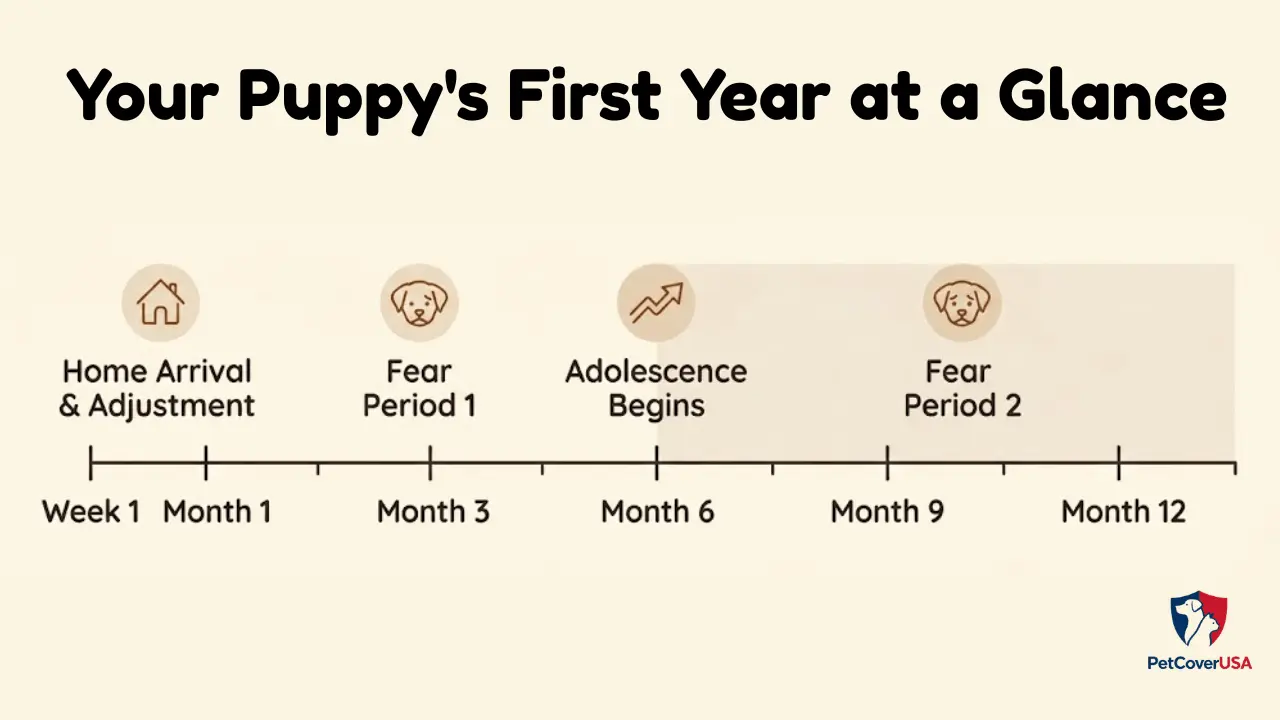
Taking care of a puppy in your home usually means making your home puppy-safe, creating a regular feeding and potty schedule, taking your puppy to the vet early on, and fostering socialization, training, and exercise over time. Most resources online tend to discuss only the first week; little is said about what happens between weeks two and twelve (fear stages and adolescence, including the psychological impact). This guide discusses both weeks one and two.
- Key Takeaways
- What to Prepare Before Your Puppy Comes Home
- The First 48 Hours: What Actually Happens
- Feeding: How Much and How Often
- Potty Training at Home – Including When You Don’t Have a Yard
- The Vet Visit and Vaccination Schedule (Why the Numbers Don’t Match Across Sources)
- Socialization vs. Infection Risk: The Trade-off Most Guides Don’t Explain
- Fear Periods: Why a Confident Puppy Can Suddenly Seem Scared of Everything
- Puppy Biting and Teething: What’s Normal, and When It’s Not
- Crate Training, Nighttime Crying, and the Separation Anxiety Question
- The “Puppy Blues”: The Part of Puppy Ownership Almost Nobody Writes About
- Puppy Adolescence: The Second Difficult Stage Nobody Warns You About
- Spay, Neuter, and Microchipping: Timing Considerations
- What It May Cost to Take Care of a Puppy at Home
- Common Misunderstandings About Puppy Care
- Frequently Asked Questions
Key Takeaways
- Care for puppies varies considerably with increased age. What a puppy needs at 8 weeks is not the same as what is needed when the puppy matures to 6 months; therefore, one single checklist cannot apply in both situations well.
- Most of the puppy care issues which have been searched for on the internet, like so-called critical learning periods, “puppy blues”, apartment potty training and socialization risks, are hardly mentioned in any guides, even though they tend to occur with most new puppy owners at one point or another.
- The timing for many trips to veterinary clinics and socialization windows varies tremendously from source to source. The purpose of this book is to provide the reasons why such variation is possible instead of picking one figure and proclaiming it absolute.
- If you feel overwhelmed, it is an established phenomenon supported with research evidence.
What to Prepare Before Your Puppy Comes Home
You’ll generally want to have a small set of essentials ready before your puppy arrives, rather than trying to shop while also managing a new puppy.
| Category | Items | Why it matters |
|---|---|---|
| Rest | Crate, playpen, or bed | Gives your puppy a consistent, low-stimulation space to settle into |
| Feeding | Stainless steel or ceramic bowls, puppy-formulated food | Metal or ceramic can be easier to keep clean than plastic, which may harbor bacteria over time |
| Walking | Collar or harness, a 4–6 ft leash | A harness may reduce strain on a growing puppy’s neck; retractable leashes are generally discouraged until basic leash manners are established |
| Chewing | Teething-safe chew toys, puzzle feeders | Supports natural chewing behavior and reduces the chance your puppy chews something unsafe |
| ID | Collar tag, microchip | A microchip can help reunite you with your puppy if they’re ever lost, though registration and contact details need to stay current |
| Cleanup | Enzymatic cleaner, waste bags | Regular cleaners often don’t fully remove the scent markers that draw a puppy back to the same accident spot |
Before your puppy arrives, it can also help to walk through your home at floor level and remove or block off electrical cords, small objects, toxic plants, and chemicals. Puppies explore with their mouths, so anything reachable is something they may try to chew.
The First 48 Hours: What Actually Happens
The first two days are about adjustment instead of training. Your puppy has most probably just come away from their mother and litter-mates and thus might be in an unfamiliar situation.
In these first couple of days we can expect our new puppy to:
- Appear calm at first, and later on to become active,
- Cry or whine at night (especially during the first nights),
- Have a potty accident even with supervision,
- Eat less than expected on the first day.
All these things do not necessarily mean that there is a problem. These observations show that this is usually a stress response due to a significant change of environment, and these symptoms normally pass as the puppy learns your house, your routine, and your voice.
A short note on the introduction: Introducing your new puppy to visitors, other pets, or large family groups on the first day may be more distressing than helpful. Most trainers recommend keeping the first couple of days low-key without too much stimulus.
Feeding: How Much and How Often
Puppies generally have higher calorie and nutrient needs relative to their body weight than adult dogs, because they’re growing quickly.
| Puppy age | Typical meal frequency | Notes |
|---|---|---|
| 6–12 weeks | 3–4 meals per day | Smaller, more frequent meals may support digestion at this stage |
| 3–6 months | 3 meals per day | Portion sizes generally increase as the puppy grows |
| 6+ months | 2 meals per day | Many puppies transition around the 6-month mark, though this can vary by breed and vet guidance |
The given table indicates general feeding patterns, which are not strict rules. You should consult your veterinarian for the best feeding schedule for your puppy depending on its breed and size.
Here are some facts that do not appear in most checklists or guides:
- Material of the bowl matters. Some veterinarians believe that plastic bowls can increase the risk of bacterial contamination or provoke skin irritations in puppies with sensitive skin when compared to stainless steel/ceramic bowls.
- Diet is a main topic of discussion. Some veterinarians suggest that dry, wet, or raw diet has its followers. Raw diet is particularly controversial in the veterinary world due to the high risk of bacterial infection and problems with nutrient balance. Thus, if you are thinking of feeding your dog in a specific manner, it’s sensible to talk to your veterinarian.
- Look for symptoms of sensitivity like vomiting, diarrhea, or itchiness and tell your veterinarian about them instead of changing your dog’s diet frequently by yourself.
Potty Training at Home – Including When You Don’t Have a Yard
Most puppy guides teach potty training in the same way, regardless of actual homes: Take the dog outside regularly and praise it for being successful. This doesn’t work as well when you live in a complex or any place without easy access to a yard, and this is a significant gap in advocacy, considering apartment living is so common.
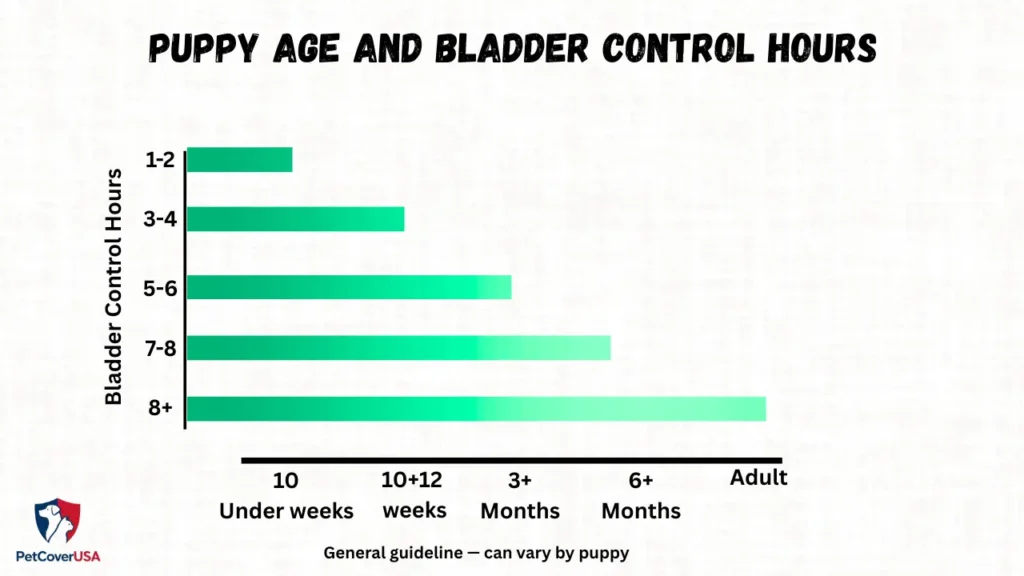
How long can a puppy actually hold it?
The common standard is about one hour of bladder control for each month of the dog’s age; however, that varies with individual dogs.
| Puppy age | Approximate bladder control |
|---|---|
| Under 10 weeks | Around 1 hour |
| 10–12 weeks | Around 2 hours |
| 3+ months | Roughly 1 hour per month of age |
| 6+ months | Up to around 6 hours |
| Adult dogs | Generally not recommended to go beyond 6–8 hours without a break |
If you don’t have a yard
There is another complication that most manuals and guides miss out; the dog owner living in apartments might experience a setback where the dog still is not fully vaccinated. Veterinarians recommend that their clients not expose their unvaccinated dog to new areas because it is risky, as that area does not guarantee the safety of the dog.
The most popular solutions involve:
- The creation of indoor grass on a balcony, porch, or yet another assigned place;
- The use of puppy pads, especially for smaller breeds;
- The availability of a constant indoor bathroom area cleaned right after the dog makes a mess to not smell the scents of what has occurred;
- Setting the hours for bathroom use, which will help avoid accidents inside the apartment.
The above-mentioned solutions are not necessarily better. Access to an actual yard helps in getting an outdoor-trained dog after vaccination, while issues with indoor training can be avoided by getting the experience of using the house during an apartment stay.
Source: Wisconsin Humane Society
The Vet Visit and Vaccination Schedule (Why the Numbers Don’t Match Across Sources)
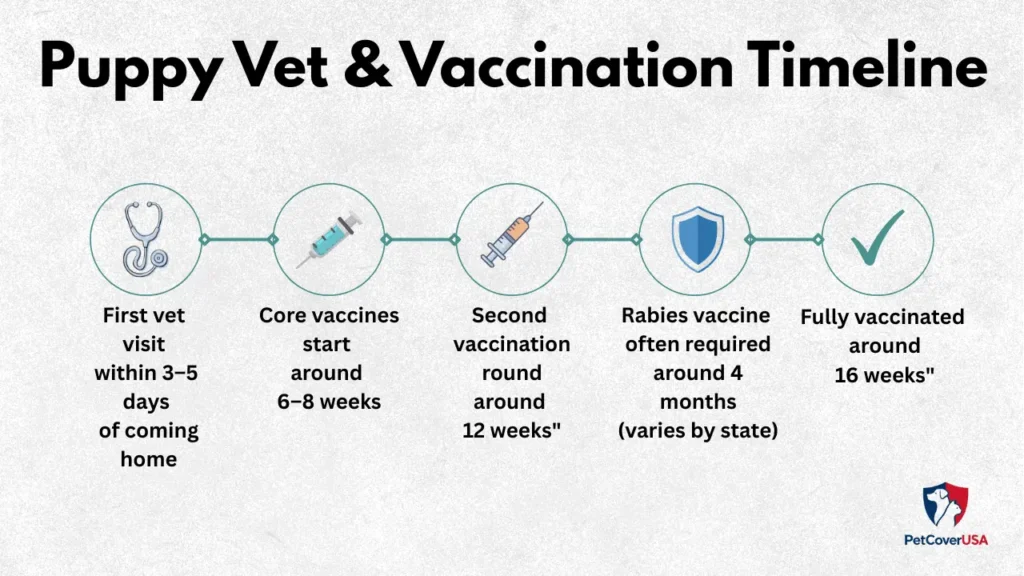
If you’ve taken some time to go through a couple of puppy care guides, you might have noticed that there seems to be a noticeable discrepancy between recommendations for the first vet clinic visit. Some say to do that within 3- 5 days after bringing the puppy home, some say to do it ‘soon,’ and yet others recommend going for the puppy check-ups every 3 to 4 weeks until the puppy is fully vaccinated.
| Milestone | Commonly cited timing | Why it varies |
|---|---|---|
| First vet visit | Within 3–5 days of bringing puppy home | Some clinics prioritize an early exam; others build it around the vaccination schedule instead |
| Core vaccine series starts | Around 6–8 weeks of age | Depends partly on when maternal antibodies (passed through the mother’s milk) are expected to wane |
| Second vaccination round | Around 12 weeks | Booster timing varies by vaccine brand and regional disease risk |
| Rabies vaccine | Often required around 4 months in the US | Legal requirement, not just medical — varies by state |
| Fully vaccinated | Often considered complete around 16 weeks | This is also roughly when the primary socialization window is closing, which creates a genuine scheduling tension (see next section) |
But rest assured, this isn’t a case of one being right and the other wrong; vaccination protocols can vary from clinic to clinic, from region to region, and from puppy to puppy depending on the level of risk. What matters more than knowing the specific number is knowing when to schedule your visit with your vet.
Socialization vs. Infection Risk: The Trade-off Most Guides Don’t Explain
This appears to be the most perplexing contradiction in puppy care advice from credible sources. On one hand, we read about the importance of early puppy socialization. On the other hand, we see warnings about keeping unvaccinated puppies away from other dogs and public places.
The contradiction may seem perplexing; however, both pieces of advice are correct. The true situation has been described by veterinary behaviorists many times – quite frankly and without disguising the facts.
The basic argument seems to be as follows:
- The first socialization period occurs when puppies develop a positive attitude towards different people, animals, sounds, and places. This period is believed to last from 12 to 16 weeks of age.
- Puppy vaccines do not provide complete protection immediately, and the level of protection depends on the vaccine schedule, the puppy’s age, and local disease risk.
- Delaying the beginning of socialization leads to a longer waiting time for the opportunity to develop non-fearful behavior or even fear-related behavioral problems in puppies.
- Taking an incompletely vaccinated puppy to busy public areas or allowing contact with unknown dogs can expose them to infections such as parvovirus. The level of risk depends on local disease activity and the environment, so ask your veterinarian which socialization options are appropriate.
Controlled socialization is often considered to be the theoretically best type of socialization. This implies a combination of neither complete isolation nor unrestrained exposure to other dogs, as recommended here:
- Create controlled encounters with other adult, healthy, and vaccinated dogs in “low risk” locations (a friend’s yard instead of a dog park)
- Travel with the puppy in a car, through carrying walks, and up to a vast number of sights and sounds without the puppy stepping on the ground with heavy pedestrian traffic
- Enroll your puppy in classes for vaccinated puppies rather than open-access classes
- Let different persons visit you at your home
It is always better to consult your veterinarian about the decision you are going to make, since the prevalence of disease in that area, puppy breed, and environment will determine the level of real risk. If your vet is inclined to suggest a more conservative or more liberal strategy than the one suggested in this guide, this is totally normal.
Source: AVSAB (official position statement PDF)
Fear Periods: Why a Confident Puppy Can Suddenly Seem Scared of Everything
This is an entirely established developmental phase that is hardly ever mentioned in common “how to care for a dog” articles, although a good part of first-time pet owners confirms that something like that has happened with their puppies.
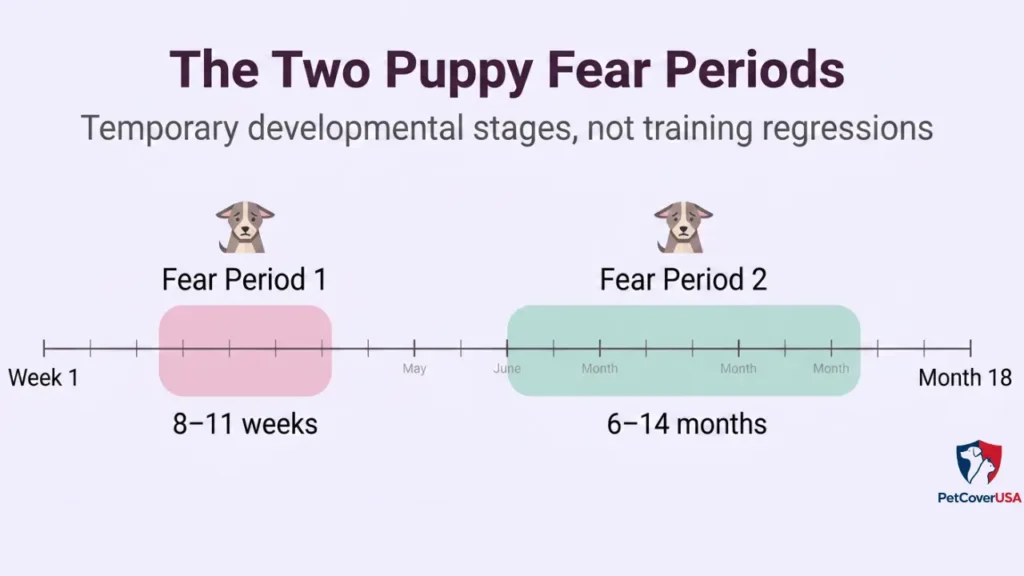
Puppies commonly go through two identifiable fear periods:
| Fear period | Typical age | What it can look like |
|---|---|---|
| First fear period | Roughly 8–11 weeks | Sudden hesitance around previously fine objects, people, or sounds; this window often overlaps with when the puppy first arrives home |
| Second fear period | Roughly 6–14 months | A puppy that seemed confident suddenly becomes anxious around familiar things; often mistaken for a training regression |
Every stage is considered to last about 2–3 weeks, but it is not uncommon for some puppies to experience slightly longer periods.
What is supposed to work is being reported by those writing about dog behaviors: do not make a puppy approach a frightening thing or engage with it, and let the animal stay in a safe zone, observe from there, or come back when ready. Instead of demanding action, it is recommended to praise calm behavior, even if it is limited to just looking at the object. In addition, forcing the animal to confront its source of fear is not supported, as it may end up producing the opposite outcome.
In case of an extreme fear reaction that does not disappear after a few weeks or gets applied to an extensive range of objects, a vet or an animal behavior researcher is to be involved instead of waiting until the problem eventually fixes itself.
Source: American Kennel Club – Fear Periods
Puppy Biting and Teething: What’s Normal, and When It’s Not
Several usual sources bring forward the idea of “redirecting to a chew toy,” but this advice doesn’t reflect the reality of what many pet owners are looking for when addressing dog teething, specifically, biting hard enough for blood to come out.
According to veterinary experts, the most pronounced phase of teething-related biting typically occurs in dogs aged between 2 and 6 months, when permanent teeth are coming in and gums are sore. Even though the whole process may be hard for you to go through, biting hard enough for blood to appear is not something unknown at this stage.
Some helpful suggestions to keep in mind based on the advice provided by trainers:
- Have a variety of proper chew toys ready at hand so it’s possible to redirect your puppy’s attention before it bites.
- Avoid screaming excessively and then pulling your hand away quickly, as some trainers think such actions may make the overstimulated puppy even more active.
- Seek the pattern associated with the bites: if there were stronger bites when your puppy was tired, bored, or overstimulated, make sure that you will provide your puppy with a good nap or less energizing activity instead of punishment.
- If the bites seem to become more frequent or stronger rather than less frequent during the period of several weeks, it’s much wiser to contact a professional trainer as opposed to assuming that this matter can be resolved with time itself.
It would also be wise to contact your veterinarian as soon as biting occurs and skin is broken because a veterinarian can help determine if the problem is serious or not and provide you with guidance tailored specifically to your puppy.
Crate Training, Nighttime Crying, and the Separation Anxiety Question
Every novice pet parent generally experiences their puppy crying when they are kept undisturbed and alone, even though newly adopted pet parents will question if their fur babies have separation anxiety. Experienced pet owners have informed almost everyone that almost all adjustment responses are common rather than any medical issue.
| Sign | More consistent with normal adjustment | More consistent with separation anxiety |
|---|---|---|
| Timing | Crying decreases over days to a couple of weeks | Distress persists or worsens over weeks |
| Behavior | Whining, some restlessness | Destructive behavior, drooling, attempts to escape the crate |
| Triggers | Occurs mainly at bedtime or when first left alone | Occurs even during brief absences or when the owner is just in another room |
| Elimination | Normal potty patterns | Accidents even shortly after a potty break, tied to distress rather than a full bladder |
Many trainers have suggested that one should not hurry to get to the stage of formal alone training in the first few days and should instead put the emphasis on establishing a solid relationship. Trainers believe that puppies that can trust their owners to come back will be better equipped to endure alone time.
In the case the pet shows continuous signs of separation anxiety, either because of consistent behaviour fitting the description above, or the illness persists after the first few weeks, making an appointment with a veterinarian or a certified trainer is highly advised.
The “Puppy Blues”: The Part of Puppy Ownership Almost Nobody Writes About
This could very well be the most important content gap on this subject. Most guides treat acquiring a puppy as an experience that is only positive. However, for many owners, experiences in the early weeks with their puppies can instead be emotionally taxing, and studies have started to explore this issue.
Researchers have called this experience “puppy blues,” which is obviously analogous to the “baby blues” that some new parents have. It is critical to describe what it is and what it is not: it is not a clinical diagnosis but has been the object of study. The University of Helsinki created an instrument called “Puppy Blues Scale,” which facilitates the study of difficulties that new puppy owners face — the results of our findings are to be published in a peer-reviewed journal.
In a different survey, a pet insurance company queried about 600 puppy owners and found the following (it must be remembered that this is self-reported data and not clinical data).
- Respondents who acted as individual caretakers for their puppies have reported experiencing higher levels of anxiety and depression when compared to the respondents who acted as joint caretakers.
- A fair number of individual caretakers mentioned having considered putting their dogs up for adoption.
- In the process of conducting the survey, the researchers uncovered that regret differs by the gender of the respondents, where the male respondents regretted the decision they made more than females.
Also, the similarities between different research sources are that the feelings described tend to come at their peak exactly during the first weeks after getting a puppy and usually calm down later.
If you find yourself reflecting the feelings of individuals whose experience is described above, this is a well-documented and researched specific adjustment facet. If the feelings of unhappiness, anxiety, and desperation linger on for too long, it is worth getting a qualified answer from a healthcare professional.
Source: npj Mental Health Research (Nature journal)
Puppy Adolescence: The Second Difficult Stage Nobody Warns You About
If everything goes smoothly during the first few weeks, it can be tempting to believe that the worst part is finished. Around 6 months of age, however, many dog owners notice that their once obedient puppy surprisingly “forgets” all manners of training.
Scientific evidence backs this notion. A study by Newcastle University scientists, published in a respected journal, Biology Letters, showed that there exist measurable signs of a teenage phase in dogs, which appear in the form of their decreased responsiveness to the commands of their main caregiver (but not to those of any stranger) around the age of 8 months, among other features of the behavior measured. The results of the study also suggest that the effect manifests itself in dogs without developed attachment to the owner.
Some behaviors generally associated with teenagers are:
- A slowed or uneven response to commands that had always been followed
- An increased push against boundaries
- A short-lived dropping off in both leash skills and recall
This phase is typically thought to be temporary, although it may actually go on longer than the puppy stage. It is usually thought of as lasting from 6 months to about 2 years of age, depending on breed and whether or not the dog is considered a puppy. This is also very interesting in understanding why some dogs end up in shelters after this period, as it contributes to misinterpretation of interest and behavior on the part of owners.
Some things that are commonly recommended to do at this stage are going back to some basic obedience training in short sessions without putting too much stress on the dog and changing expectations rather than assuming the dog is misbehaving.
Source: Newcastle University press release
Source: Cornell Riney Canine Health Center
Spay, Neuter, and Microchipping: Timing Considerations
While standard references often simplify the spaying/neutering issue to one number (“approximately 6 months”), that is no longer the only perspective on the matter, and some new information and studies resulting from it may be important to note.
Commonly reported facts regarding spaying/neutering are the following:
- While spaying/neutering has been traditionally seen as an event occurring at the 6-month age of your pet, the recommendations regarding this may significantly vary depending on breed, size, and health condition of the pet
- While some studies conducted by veterinary specialists in regard to the bigger breeds indicate that early spaying/neutering may negatively affect the joints and the orthopedic system, this is an important reason why the timing is personalized now, no longer being a general rule
- Microchip identification for pets is rather reliable and safe, but still requires making sure that the microchip registration data remain updated to make it efficient
Since this varies depending on a number of factors, including breed, size, and the vet’s responsibility, don’t rely on the “6 months rule” as the only thing.
What It May Cost to Take Care of a Puppy at Home
Depending on the breed, location, and food and insurance choices, the estimates of cost can differ greatly, so a single number should be understood as just an estimate that can’t be relied on.
A pet insurance industry provider calls the annual estimate the first-year pet parent cost of between $1,600 and $2,000 (USD). This figure is calculated according to various factors, such as food, grooming, training, pet sitting, and daycare, as well as medical visits and insurance expenses. The calculations are based on only one organization, so the figure should be regarded as just an estimate, without the claim to extreme accuracy.
Speaking about pet insurance specifically: there is a great difference in policies, exclusions, waiting periods, and reimbursement from one provider and even from one plan to another by one provider. If you think of getting a policy, there are many details which are essential to know: what is excluded, how pre-existing conditions are defined, and what is the exact waiting period, among others.
Common Misunderstandings About Puppy Care
| Misunderstanding | More accurate framing |
|---|---|
| “Crying at night means separation anxiety” | Usually reflects normal adjustment stress in the first days to weeks |
| “You must wait for full vaccination to socialize” | Controlled, low-risk socialization before full vaccination is commonly recommended by veterinary behaviorists, not just tolerated |
| “A puppy who suddenly seems scared has regressed” | Often a normal fear period rather than a training failure |
| “A puppy who stops listening around 6 months is being disobedient” | Often reflects a documented adolescent developmental stage |
| “Feeling overwhelmed means you’re a bad puppy owner” | A researched and reasonably common experience during the early adjustment period |
Frequently Asked Questions
How long does it typically take a puppy to adjust to a new home?
Many puppies show noticeable improvement in comfort and routine within the first one to two weeks, though full adjustment, including consistent potty training and settled nighttime behavior, commonly takes closer to a month. Individual puppies and circumstances vary.
Is it normal for a puppy to cry every night at first?
Some crying in the first several nights is commonly reported and generally considered a normal adjustment response rather than a sign of a problem. If crying persists unchanged for several weeks or is accompanied by other distress signs, it’s worth discussing with your vet or a trainer.
Can I socialize my puppy before they’re fully vaccinated?
Controlled, low-risk socialization, such as meeting healthy vaccinated dogs in private settings, car rides, and exposure to new people at home, is commonly recommended by veterinary behaviorists even before a puppy’s vaccine series is complete. Higher-risk exposure, like dog parks or areas with unknown dog traffic, is generally discouraged until vaccination is further along. This is best confirmed with your own veterinarian.
Why does my puppy suddenly seem scared of things they were fine with before?
This can reflect a fear period, a commonly documented developmental stage that typically occurs around 8–11 weeks and again around 6–14 months. It’s generally considered temporary and is not usually a sign that something has gone wrong.
At what age do puppies typically become easier to manage?
There’s no single answer, since it depends on breed, individual temperament, and training consistency. Many owners report noticeable improvement after the initial adjustment period (first few weeks) and again after the adolescent stage (roughly 6 months to 18–24 months) tapers off, though this varies considerably.
Is it normal to regret getting a puppy?
Feelings of overwhelm, exhaustion, or temporary regret in the early weeks have been documented in research on new puppy ownership and are commonly reported, particularly among owners without a co-caretaker. This doesn’t necessarily reflect a poor decision or a lack of attachment, though persistent or serious distress is worth discussing with a healthcare professional.
📅 Last Updated:
Related Puppy Care Guides
Crate training is an important part of helping a puppy adjust to a new home. See our guide to helping a puppy stop crying in the crate at night for practical guidance.
If you’re a first-time dog owner, you may also want to understand your options for veterinary expenses. Read our guide to pet insurance for first-time dog owners .
Nutrition is another important part of raising a healthy puppy and dog. You can also explore our guide to food for small dogs with sensitive stomachs .
Dental care should also become part of your dog’s routine. See our dog dental care tips for healthy teeth for practical oral-care information.
If you’re researching pet insurance more broadly, our guide to comprehensive pet insurance coverage explains additional policy features to consider.

About the Author
M. Nouman is an independent researcher and writer focused on U.S. pet insurance. He reviews insurer policy documents, coverage terms, waiting periods, reimbursement options, exclusions, and publicly available veterinary and regulatory resources to create clear, research-based guides. His goal is to simplify complex insurance information so pet owners can make informed decisions based on reliable sources rather than marketing claims. Articles are reviewed and updated as policies and industry information change.
Areas of Research: Pet Insurance Policies, Coverage Analysis, Policy Comparisons, Waiting Periods, Reimbursement Models, Policy Exclusions, Claims Education