
How to Stop Your Puppy From Crying in the Crate (Without Making It Worse)
If your puppy cries every time you shut the crate, it’s understandable that you’re feeling exhausted, guilty, and confused about whether to give your puppy some attention or to let it be. There is nothing wrong with having these feelings, as crate crying is a common issue that new puppy owners experience, and people usually get generic advice on how to resolve it, being taught that it is just one problem with one solution.
There are different kinds of crying: part of it is normal for the new environment, whereas some crying can be telling you something specific about the state of your puppy: having to pee, the crate being too large, or even panic, which is different from mere whining.
If all this sounds familiar to you, you are not alone. Most of the new puppy owners face the same problem.
Quick Answer
Crying in a puppy crate is often a normal reaction due to being away from the litter and being put in a new environment. Naturally, the only way to deal with it depends on the reason for the puppy’s crying. A puppy that has to go outside to toilet, one that is anxious, and one that is genuinely at risk are likely to require different treatments. Should the crying accompany vomiting or stress or last for weeks with no improvement, a veterinarian or animal behavior expert must be consulted.
The goal is not to shut every sound immediately; instead, the goal is to understand whether the puppy is adjusting normally or you really need something else. For practical settling tips, some vets suggest keeping the crate near you at first so the puppy feels less alone. Vet Help Directvethelpdirect
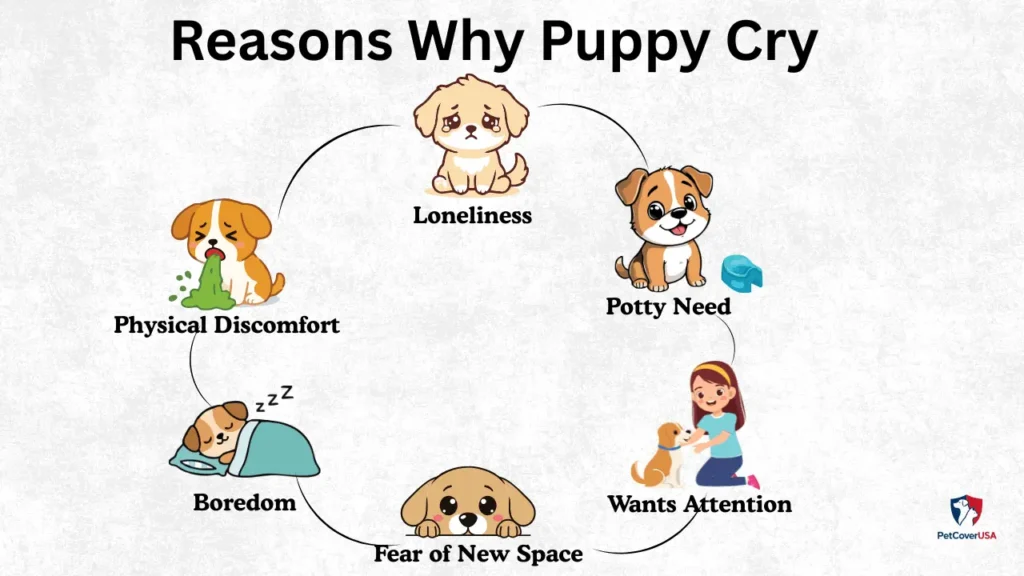
Why Puppies Cry in the Crate
| Likely Reason | What It Often Looks Like |
|---|---|
| Missing littermates/loneliness | Crying that’s worse the first few nights, softens with time |
| Needing the bathroom | Restless pacing before vocalizing, cries in short bursts |
| Fear of an unfamiliar space | Crying starts as soon as the door closes, regardless of time of day |
| Wanting attention | Cries that seem to increase when you’re nearby, not when you’re gone |
| Boredom or excess energy | Crying paired with a lot of movement, chewing, or pawing at the door |
| Physical discomfort (crate size, temperature, teething) | Crying doesn’t improve even with a consistent routine |
No single list can cover every young pup, and temperament plays a major part in whether or not other young pups do adjust right away. Some young pups integrate into their families after just a couple of nights, while others may take significantly longer to adjust, but that is perfectly normal and does not imply anything is wrong.
In the real world, there is no just a single reason; instead, it may be two or more. Therefore, it may not be useful to apply the same routine to every puppy.
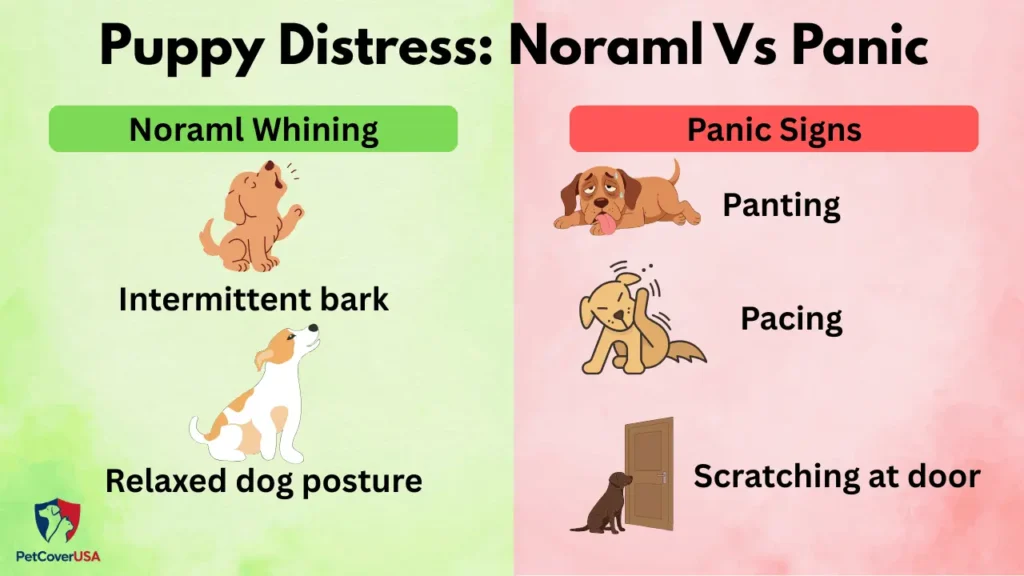
Normal Whining vs. a Genuine Panic Response
This is one of the more overlooked distinctions in crate training advice, and it’s arguably the one that matters most for how you respond.
| Normal Protest Whining | Possible Panic / Distress Response |
|---|---|
| Intermittent, softer in tone | High-pitched, repetitive, doesn’t let up |
| Puppy settles within a few minutes | Escalates the longer it goes on |
| Calm body language between cries | Panting, drooling, pacing, lip-licking |
| Stops when you make noise nearby | Continues even with reassurance |
| Mild pawing at the door | Frantic scratching, biting at the crate bars |
If puppy behavior is akin to column two, there are some dog trainers who would recommend that letting the puppy “cry it out” may not be the best way to address the situation. A softer approach is preferable, like sitting near the crate or comforting the puppy for a short amount of time at least without opening the door. In case the same pattern continues for longer than a few weeks, even despite adhering to the same routine of behavior, such a case would be a good reason to contact a pet professional instead of continuing to solve the issues individually.
If you don’t understand whether this is normal whining or panic, it may be better to wait and choose a second opinion than to assume that puppy will simply grow out of it. GeniusVets
What About “Cry It Out”? What the Evidence Actually Suggests
The opinion of dog trainers on this subject is drastically split, and it’s better that we say that straight away before giving you a side to take. A lot of trainers will suggest allowing your puppy to make some noise and whine it out, while others will contend that exposing your puppy to oral distress continually could be counterproductive to crate training in the long, long run.
There is no one-size-fits-all answer to this problem because it’s also the reason why understanding the difference between normal whining and panic is essential. If you don’t know yet where your furry friend belongs, it will be a good idea to consult an animal behaviorist or a dog vet.
Because of this, sometimes crate training online advice may look confusing. Two people may show different outcomes while using almost the same thing.
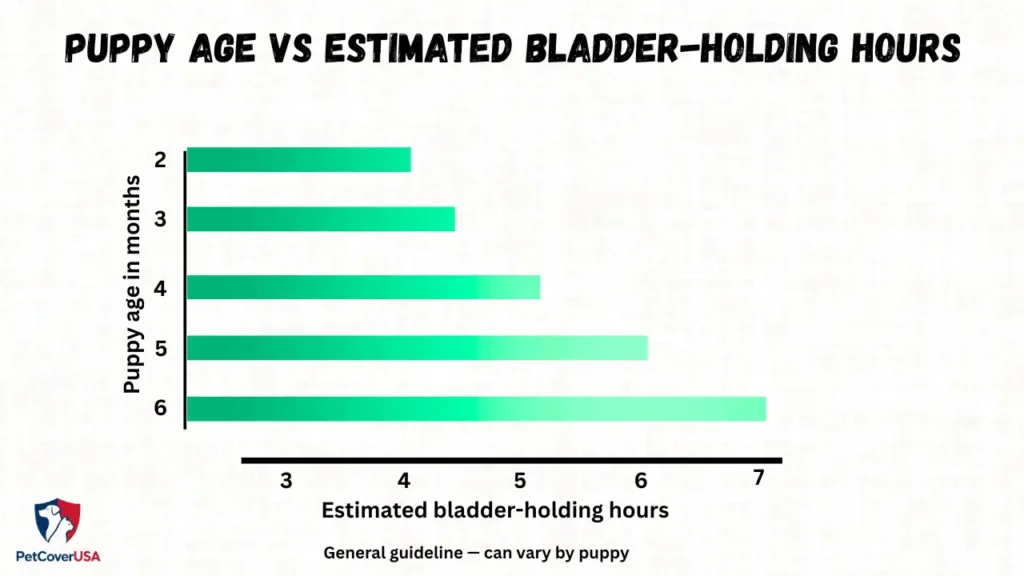
The Bladder Question
A common rule used by trainers suggests that a puppy’s age in months, added to one, can indicate how many hours the puppy can hold its bladder – so for instance, a two-month-old puppy would be able to hold its urine for about three hours. Of course, it needs to be noted that this is only a rough guideline and each puppy may behave differently depending on its age, breed, and the amount of time since the last visit outdoors. If accidents keep on occurring even when frequent bathroom breaks are provided, it may be time to consult a veterinarian in order to rule out any health problems involved.
When in doubt, a few extra potty breaks are usually easier to manage than cleaning up repeated accidents later.
Three Things Most Guides Skip
If crying turns into vomiting
If crying leads to vomiting, while throwing up due to stress or a crying-induced upset stomach may happen once in a blue moon, vomiting too much, being lethargic, or having the pup being uncharacteristically “off” are among the reasons to call your vet instead of waiting indefinitely to see how things will develop — some underlying issues may be more serious and resemble benign behaviors in the first stages.
If neighbors are the ones losing sleep
If the neighbors are the ones suffering. In an apartment or house or wherever people share a wall, crying in a crate might become a question of noise too quickly. Making sure to inform your neighbors before bringing your new dog home, as well as letting them know that it may take a several-week period before your dog settles down to sleeping comfortably, will be very helpful, as a lot of the complaints in these situations stem from the element of surprise rather than the noise itself.
If week two feels worse than week one
Experiencing a brief downturn after seeing results is nothing out of the ordinary and does not mean that training has been unsuccessful. It can just be a phase your puppy is experiencing, or it could mean something has changed in their daily schedule, and in such cases, the results will usually come back.
Sometimes the most difficult part is not the crying; instead, it is understanding whether you are helping or increasing the problem by mistake.
Getting Your Puppy to Love Their Crate
- Start giving your puppy its meals in the crate every now and then, and not just before bedtime.
- Practice short training sessions with your puppy inside the crate while you are in the same room.
- Do not open the door at the moment your puppy starts whining, but wait until a period of silence occurs first.
- Make sure that the size of your puppy’s crate is correct since one that is too big can result in the puppy being allowed to “go” at the other end of the crate.
- Use a familiar blanket that retains your puppy’s scent and fill your puppy’s crate with a blanket and some music.
Progress may look smaller at the start, so it is better to consider it to achieve it in weeks or months, not in a single perfect night. AKC recommends making the crate a positive place with short sessions, the right size, and calm repetition rather than using it as punishment. AKCakc
FAQ’s About How to Stop Your Puppy from Crying in the Crate
Is it normal for a puppy to cry every night in the crate?
For the first several nights, yes, this is commonly reported and generally considered a normal adjustment response. If it hasn’t eased at all after two to three weeks of consistent routine, that’s usually worth mentioning to a vet or trainer.
Should I take my puppy out every time they cry?
Not necessarily every time — doing so can teach a puppy that crying reliably gets the door open. Many trainers suggest waiting for a brief pause in the crying before opening the crate, unless the crying clearly points to a bathroom need.
Is it okay to sleep near the crate the first few nights?
Many trainers view this as a reasonable short-term step, especially in the first few nights, and it doesn’t necessarily undo independence training if it’s gradually phased out afterward.
Why does my puppy cry more when I’m in the room than when I leave?
This is reported often enough to be considered a fairly normal pattern. Some puppies settle faster once they can’t sense you nearby, though this isn’t universal.
When should I actually worry?
Persistent crying that isn’t improving after a few weeks, crying paired with repeated vomiting or other symptoms of illness, or signs of extreme panic (frantic escape attempts, injury from the crate) are generally reasonable reasons to consult a vet or certified behaviorist rather than continue troubleshooting on your own.
📅 Last Updated:
Related Puppy Care Guides
If you’re bringing home a puppy for the first time, our guide to taking care of a puppy at home covers other important parts of a puppy’s daily routine and care.
New dog owners may also want to understand pet insurance before unexpected veterinary expenses arise. See our guide to pet insurance for first-time dog owners .
If you’re comparing policy features and broader protection, our guide to comprehensive pet insurance coverage provides another useful resource.
Diet is another important part of caring for a young dog. You can also read our guide to food for small dogs with sensitive stomachs .
For practical oral-care advice as your puppy grows, see our dog dental care tips for healthy teeth .

About the Author
M. Nouman is an independent researcher and writer focused on U.S. pet insurance. He reviews insurer policy documents, coverage terms, waiting periods, reimbursement options, exclusions, and publicly available veterinary and regulatory resources to create clear, research-based guides. His goal is to simplify complex insurance information so pet owners can make informed decisions based on reliable sources rather than marketing claims. Articles are reviewed and updated as policies and industry information change.
Areas of Research: Pet Insurance Policies, Coverage Analysis, Policy Comparisons, Waiting Periods, Reimbursement Models, Policy Exclusions, Claims Education